 ExSpade
Blackjack Odds Depend on the Rules, Not Just the Cards
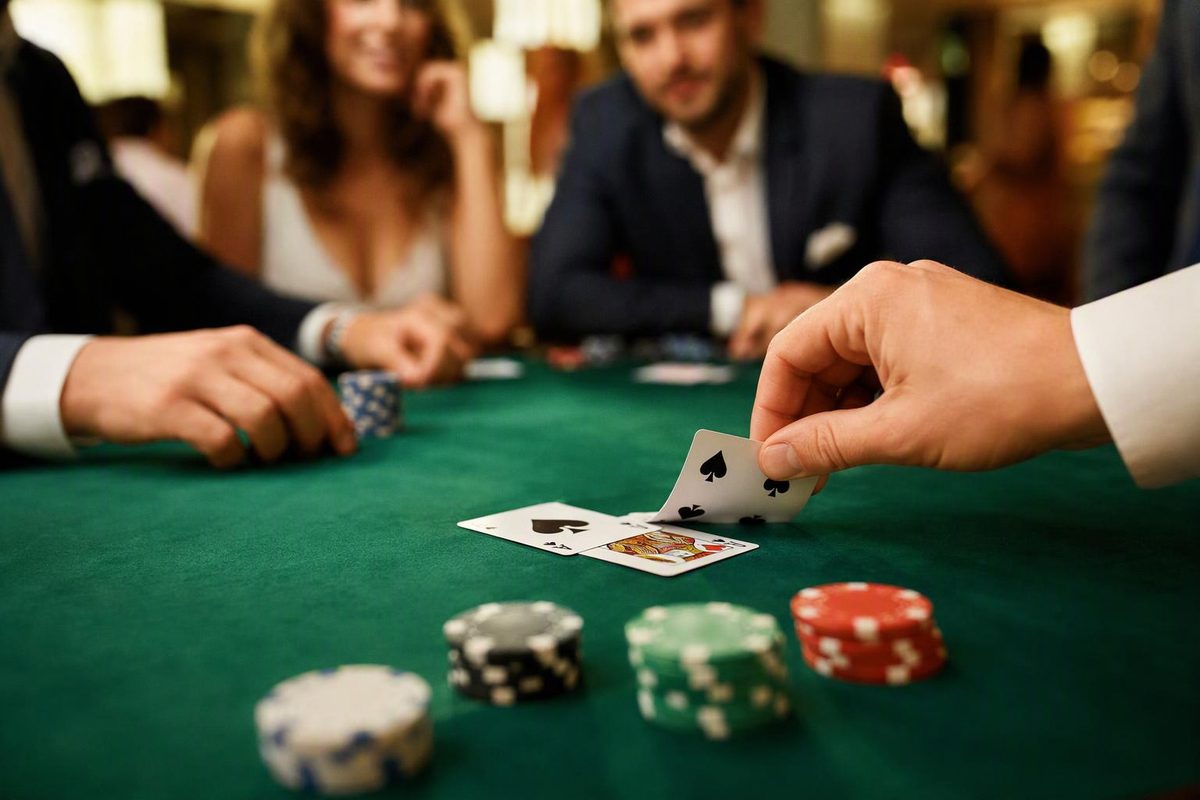
Blackjack does not have one universal set of odds. The number of decks, blackjack payout, dealer’s soft-17 rule, doubling restrictions, surrender and your playing decisions all change the result.
Separate three ideas when comparing games:
- Probability: how often an outcome occurs.
- Payout: what the casino pays when it occurs.
- House edge: the average loss per initial dollar wagered under the rules and strategy used in the calculation.
A hand can win fairly often and still have negative expected value, because wins and losses are not always the same size.
Win, push and loss odds under one ruleset
The following figures assume six decks, dealer stands on soft 17, double on any first two cards, double after splitting, late surrender, resplitting aces and basic strategy. Simulations of about 10 billion hands produced these one-round results:
| Net result | Probability |
|---|---|
| Player finishes ahead | 42.43% |
| Push | 8.48% |
| Player finishes behind | 49.09% |
| House edge | 0.28% |
These are net results for the round, so split and double-down outcomes are included. They are not universal blackjack percentages. Change the rules or strategy and the figures change. The simulation also found a standard deviation of 1.142 initial betting units per hand, showing why short sessions can finish far from the small long-run average loss (Wizard of Odds methodology and results).
The player can lose more rounds than they win while facing a comparatively small house edge because a natural blackjack pays more than even money at a 3:2 table, while doubles and splits put additional money into selected situations.
Odds of being dealt a blackjack
A natural blackjack is an ace plus any ten-value card as the first two cards. In a freshly shuffled six-deck shoe there are:
- 312 total cards
- 24 aces
- 96 ten-value cards
- 48,516 possible unordered two-card combinations:
312 × 311 ÷ 2 - 2,304 blackjack combinations:
24 × 96
Therefore:
2,304 ÷ 48,516 = 0.04749
The chance of receiving a blackjack is about 4.75%, or 1 in 21.1 hands, from a fresh six-deck shoe. Once cards have been dealt, the exact probability changes with the remaining composition.
A natural is distinct from reaching 21 with three or more cards. Washington State’s published blackjack rules, for example, define blackjack as an ace and ten-value card among the first two cards; they treat a two-card 21 after splitting as an ordinary 21 paid at even money (Washington State Gambling Commission rules).
Dealer bust odds by upcard
For a six-deck game where the dealer stands on soft 17, the dealer’s probability of busting after checking for and ruling out blackjack is:
| Dealer upcard | Bust probability |
|---|---|
| 2 | 35.35% |
| 3 | 37.42% |
| 4 | 39.58% |
| 5 | 41.84% |
| 6 | 42.28% |
| 7 | 26.19% |
| 8 | 24.37% |
| 9 | 22.92% |
| 10 | 23.02% |
| Ace | 16.70% |
These figures explain why basic strategy often treats dealer 4, 5 and 6 as weak upcards. They do not mean the player should always stand against them; the correct action still depends on the player’s total and the table rules. The underlying conditional dealer-total calculations appear in the six-deck S17 table.
Why 3:2 versus 6:5 matters
At a $25 table:
- A 3:2 blackjack wins
$25 × 1.5 = $37.50. - A 6:5 blackjack wins
$25 × 1.2 = $30.00. - The 6:5 game pays $7.50 less on every winning natural.
That difference recurs because a natural appears about once every 21 initial hands. An analysis that adjusts basic strategy for each game estimates that changing the payout from 3:2 to 6:5 reduces player return by 1.39 percentage points (blackjack rule-variation table). The same analysis estimates the cost of the dealer hitting soft 17 at about 0.22 percentage points and prohibiting double after split at about 0.14 points.
Tables may offer either payout. The Venetian, for example, says its blackjack payout can be 6:5 or 3:2 depending on the game (published table-game guide). Check the felt or placard rather than assuming all blackjack is priced alike.
A checkable session-cost example
Suppose a player makes 70 initial wagers of $25 under the six-deck ruleset above, with its estimated 0.281% house edge:
70 × $25 = $1,750 of initial action
$1,750 × 0.00281 = $4.92 expected loss
“Initial action” excludes the extra chips placed on doubles and splits, but the cited house-edge estimate already includes the outcomes of those decisions. This is a long-run average, not a prediction that the session will lose $4.92. The one-hand standard deviation is about 1.142 betting units, or $25 × 1.142 = $28.55; ordinary short-run swings can therefore overwhelm the expected loss.
If the only change were a 6:5 payout, adding the estimated 1.39-percentage-point penalty gives an approximate edge of 1.671%:
$1,750 × 0.01671 = $29.24 expected loss
This second figure is a practical estimate, not an exact combined-rule analysis; rule effects need not be perfectly additive. Both figures also assume rule-matched basic strategy. Playing errors increase the cost, while betting progressions merely rearrange stake sizes and volatility.
At a fixed stake and edge, playing more hands also increases expected cost in direct proportion to initial action. Doubling the pace from 35 to 70 hands, for example, doubles the amount put through the initial-bet calculation.
Other rules to check
After rejecting 6:5, look for:
- Dealer stands on soft 17 (S17) rather than hits it.
- Double after split (DAS) is allowed.
- Doubling on any first two cards rather than only 10 or 11.
- Late surrender is available.
- Fewer decks, all else equal.
Do not compare deck count alone. A six-deck 3:2 table can be cheaper than single-deck 6:5. Use a basic-strategy chart built for the exact deck count and soft-17 rule, and compare the complete rules before relying on a quoted house edge.
Insurance is a separate wager, not protection that changes the original hand’s odds. A 2:1 insurance payout needs the dealer’s hole card to be ten-valued more than one-third of the time to have positive expected value. Immediately after only a dealer ace has been removed from a fresh six-deck shoe, the benchmark probability is 96 ÷ 311 = 30.87%, below 33.33%. The player’s own cards and every other known card change that exact probability, but insurance remains a negative-expectation wager for a player who is not tracking the shoe’s composition.
Blackjack’s price can be measured, but favorable short-term results cannot be promised. Start with the natural payout, verify the remaining rules, use the matching strategy and multiply the resulting edge by your intended action. Set a loss limit using money you can afford to lose; variance remains large even at a comparatively low-edge table.