 ExSpade
2026 Heisman Trophy Odds: CJ Carr, Arch Manning and an Unsettled Favorite
Overview
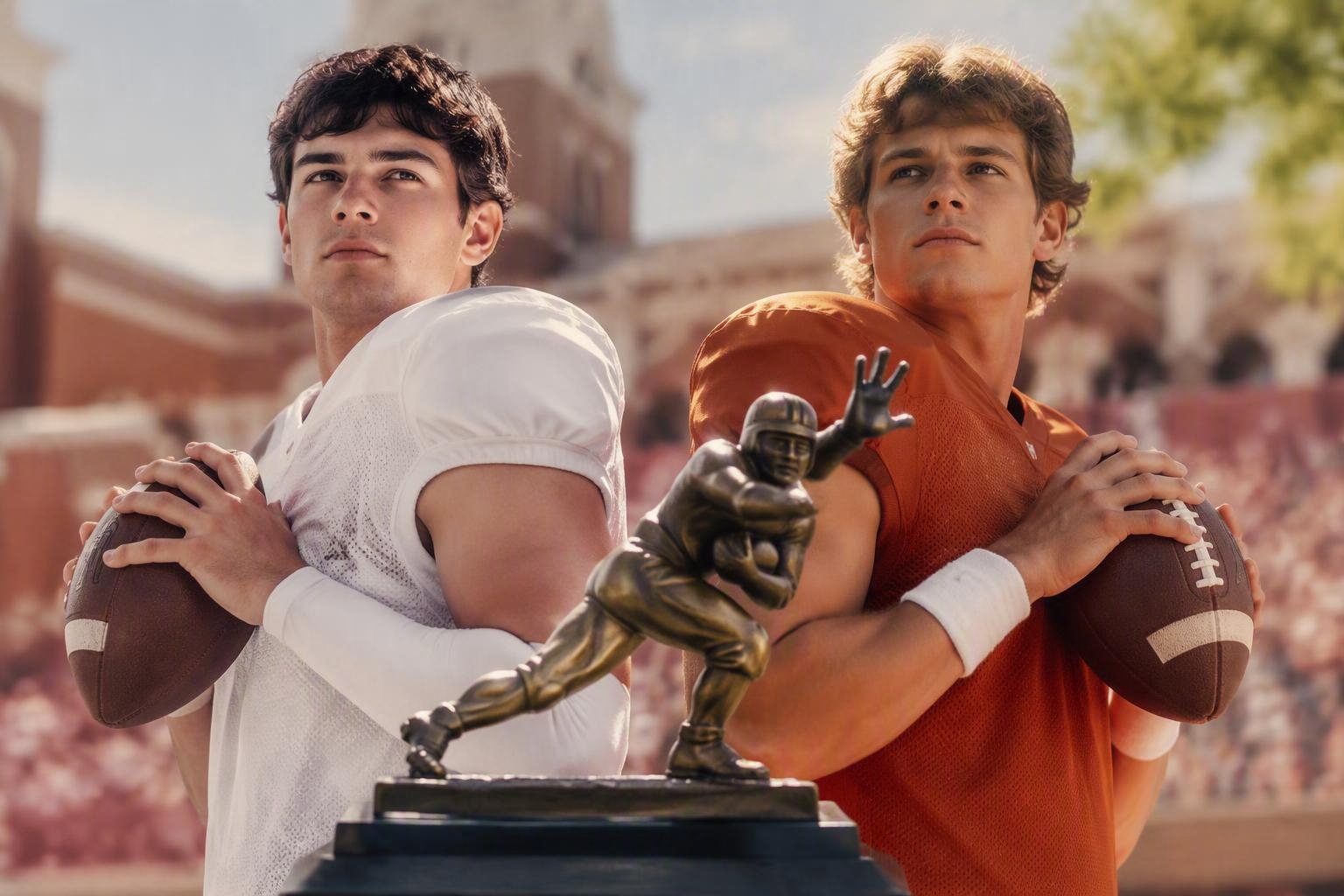
CJ Carr and Arch Manning form the leading tier in the supplied 2026 Heisman Trophy odds, but there is no universal favorite. Carr led the supplied Covers/FanDuel snapshot at +750, while Manning had been favored at +750 in the supplied Sports Illustrated/FanDuel snapshot. The deciding factor for bettors is not rank alone, but whether the available price exceeds the player’s realistic chance of winning.
That distinction matters because Heisman futures change with performance, injuries, betting activity, and sportsbook exposure. The date and operator attached to a quote are therefore part of the price. On July 5, Carr ranged from +650 to +750 across six listed sportsbooks, while Manning ranged from +700 to +800, according to VegasInsider’s comparison.
Carr’s efficiency and Notre Dame’s strong team outlook support his position. Manning offers high-end arm talent and playmaking potential, but analysts disagree about whether his performance record justifies short odds. That disagreement is useful: the favorite may be the most likely winner while still being a poor bet if the price demands too much confidence.
Current 2026 Heisman Trophy favorites and odds
The clearest recent snapshot in the supplied evidence comes from Covers on July 23, 2026. Its FanDuel board placed Carr first at +750 and Manning second at +800, followed by a large quarterback-heavy group. Those figures should be read as dated observations, not publication-time offers.
The table also shows the July 5 range reported by VegasInsider for the two favorites. Comparing the columns demonstrates how both time and sportsbook choice can change the available return.
| Contender | Position | FanDuel odds, July 23 | Cross-sportsbook range, July 5 |
|---|---|---|---|
| CJ Carr | QB | +750 | +650 to +750 |
| Arch Manning | QB | +800 | +700 to +800 |
| Darian Mensah | QB | +1100 | Not shown here |
| Trinidad Chambliss | QB | +1100 | Not shown here |
| Josh Hoover | QB | +1300 | Not shown here |
| Julian Sayin | QB | +1300 | Not shown here |
| Dante Moore | QB | +1300 | Not shown here |
| Jeremiah Smith | WR | +1300 | Not shown here |
| Gunner Stockton | QB | +1700 | Not shown here |
| Sam Leavitt | QB | +2200 | Not shown here |
“Not shown here” does not mean a price was unavailable. It means this comparison is deliberately limited to the plan’s supported cross-book range for Carr and Manning. The July 5 source listed other players and operators, but mixing every number into one apparent consensus would obscure the primary point: even the identity and price of the favorite can vary.
The change in leadership is visible across the supplied dates. Sports Illustrated’s January 14 FanDuel snapshot had Manning favored at +750 and Carr second at +800. In the supplied Covers snapshot, Carr was +750 and Manning +800 at the same named operator. That is why every usable odds quote needs a date and sportsbook.
Why the leading contenders are priced near the top
A Heisman price reflects more than raw talent. A credible contender generally needs individual production, an opportunity to remain central to the offense, team success, national attention, and performances that voters can associate with the season’s award race.
Those factors should be evaluated consistently. Proven efficiency may lower uncertainty, but a short price can erase much of that advantage. Athletic upside can create a high ceiling, but the price may already assume a major improvement. Longer-priced players may offer more return, although they often need more favorable events to reach the same winning path.
CJ Carr’s case
Carr’s case begins with efficiency and a favorable team context. Covers reported that the Notre Dame quarterback completed 66.6% of his passes and would lead a team positioned near the top of the 2026 college football win-total market. BetMGM also described Carr as highly efficient while operating Notre Dame’s offense in 2025.
That combination explains why Carr can be priced as the favorite. A quarterback who has already operated efficiently and is attached to strong team expectations has two important components of a plausible Heisman campaign. He can build his statistical case while his team’s results keep him in nationally relevant games.
Price is the complication. Carr appeared at +650 through Caesars and +750 through several other operators in the July 5 comparison. A $100 wager at +650 would produce $650 in profit if it won, while +750 would produce $750. The underlying player is identical, but the latter quote pays $100 more profit on the same stake.
Carr’s short odds also require the bettor to distinguish evidence from projection. A 66.6% completion rate is an observed statistic. Continued efficiency, elite team results, and enough defining performances to win the award remain future conditions. His candidacy may be stronger than those of longer-priced players without automatically making every Carr price attractive.
The practical question is therefore not simply whether Carr belongs first on the board. It is whether his chance is high enough to justify the specific quote available. If you like Carr, comparing operators matters because accepting +650 when +750 is available creates a needless reduction in potential return.
Arch Manning’s case
Manning’s case has a higher degree of disagreement. Yahoo’s analysis credited him with elite arm strength, natural playmaking ability, and the capacity to create the kinds of moments associated with a Heisman campaign. Those traits support a ceiling high enough to explain why he has remained near the top of the market. The same analysis nevertheless labeled Manning at +800 a pass.
The concern is not an absence of talent. It is the relationship between expectation, demonstrated performance, and price. BetMGM characterized Manning’s 2025 play as lukewarm relative to the unusually high expectations surrounding his first season as Texas’ full-time starter. CBS Sports likewise passed on Manning and noted that he had opened the previous season as the Heisman favorite at +550.
A demanding schedule has a two-sided effect in a Heisman evaluation. Difficult opponents increase the chance that uneven performances or losses weaken a candidate’s case. The same setting can provide nationally visible opportunities for defining victories and individual performances. The supplied evidence does not support a game-by-game projection, so this should remain a framework rather than a forecast about particular matchups.
Manning’s price history also shows why reputation cannot be treated as probability. He was +750 and favored in the supplied FanDuel opening-odds snapshot, then appeared at prices from +700 to +800 in the July 5 comparison. The +800 quote gives a bettor a better potential return than +700, but both still require Manning to convert physical ability into a complete award season.
His upside is clear enough to justify favorite-tier consideration. The contested issue is whether the market has left an adequate margin for uncertainty. A bettor can reasonably believe Manning is capable of winning while rejecting a price that already assumes a substantial chance of that outcome.
The next tier and longer-priced contenders
The supplied Covers/FanDuel snapshot placed Mensah and Chambliss at +1100, followed by Hoover, Sayin, Moore, and Smith at +1300. Those prices offer more potential return than Carr or Manning, but each candidate still needs a credible path through production, team success, opportunity, and voter attention.
The next tier can be scanned by identifying what the price appears to demand:
- Darian Mensah and Trinidad Chambliss: Both were +1100 in the supplied Covers/FanDuel snapshot. Their placement shows that the market treated them as part of the immediate group behind Carr and Manning, not as remote outsiders.
- Julian Sayin: BetMGM quoted the Ohio State quarterback at +1100 in its snapshot, while FanDuel listed him at +1300 in the supplied Covers/FanDuel snapshot. His presence near the top reinforces the quarterback depth facing every candidate.
- Dante Moore: Moore was +1300 in both the supplied FanDuel opening-odds board and the supplied Covers/FanDuel board. The July 5 comparison, however, ranged from +900 to +1300 across listed operators.
- Jeremiah Smith: The Ohio State wide receiver was +1300 in the supplied Covers/FanDuel snapshot. His case requires not only elite production but a way to overcome the positional advantage enjoyed by quarterbacks, including teammate Sayin.
- Josh Hoover: Yahoo identified Hoover as its dark horse at 16-1. That is an attributed analyst selection, not proof that Hoover had the best available price or objective winning chance.
- Keelon Russell: Covers published a Russell selection at +3500, but it also reported that neither Russell nor Austin Mack had been named Alabama’s starting quarterback. That unresolved role materially changes the thesis.
These cases demonstrate why “dark horse” is not synonymous with “value.” A longer price increases the payout, but it can also reflect a less certain starting role, a weaker path to team success, greater positional difficulty, or more performance improvement already required.
Historical examples show that an early long price can occasionally precede a winning campaign. CBS noted that 2025 winner Fernando Mendoza opened around +6000 and that Joe Burrow appeared around +10000 after being absent from many early 2019 boards. Those examples establish possibility, not a reliable method for selecting the next long shot.
Most likely winner versus best value bet
The most likely winner is the player with the strongest estimated chance of receiving the award. The best value bet is the player whose chance, in your assessment, is greater than the probability implied by the available price. Those are different judgments.
Four labels are useful if they are kept precise:
- A favorite has one of the shortest market prices.
- A value bet offers a price that is longer than your evidence-based estimate warrants.
- A dark horse has a longer price and a plausible but less direct winning path.
- A pass is a candidate you decline at the quoted price, even if you think he can win.
The July snapshots illustrate the distinction. Carr’s position at the top of the board indicates market favoritism in that particular snapshot. It does not prove that +750 is a positive-value wager. Manning’s presence at +800 shows a high market ranking, while Yahoo and CBS both independently used “pass” framing for him. Conversely, Covers selected Russell at +3500 even though his starting role was unresolved in the same supplied Covers snapshot.
These opinions conflict because value depends on an estimate, not just the displayed number. One analyst may place more weight on Manning’s physical ceiling. Another may penalize his uneven 2025 assessment or reject the uncertainty embedded in a short price. A Russell backer may view +3500 as sufficient compensation for the unresolved role. Another bettor may refuse to price a player before knowing whether he will start.
Recent favorite performance supports skepticism toward automatic short-price bets. Yahoo reported that only one preseason betting favorite since 2014 had gone on to win the Heisman. That does not mean favorites should always be faded. It means the preseason market has not converted its top-ranked player often enough to treat favorite status as a recommendation by itself.
A workable value process is to separate the player from the price. First, assess the candidate’s production, role, team outlook, exposure, and route to defining performances. Then translate the offered odds into a raw implied probability. Finally, ask whether your estimate is higher by enough to account for uncertainty and the sportsbook’s margin.
For example, you could rank Carr as the most likely winner but pass at +650 because the implied threshold is too demanding. You could then accept +750 if that price better compensates you for the same uncertainty. Nothing about Carr’s football case changed between those choices. Only the cost of the wager changed.
Betting popularity is another separate concept. A player can attract attention because of his name, program, fan base, or recent highlights. That activity may influence the sportsbook’s liability and price without proving that the player’s objective chance increased by the same amount. Market rank is useful information, but it is still an input to your assessment, not a substitute for one.
What usually creates a winning Heisman campaign
A strong Heisman campaign usually combines individual production with a team and narrative environment that keeps the player visible. Yahoo summarized the necessary ingredients as production, winning, national exposure, and a story that builds from week to week. It also emphasized an elite team capable of winning 11 or 12 games and defining moments against quality opponents.
Those factors are not a deterministic formula, but they provide a practical candidate screen:
- The player must produce at a level that separates him from alternatives at his position.
- His team’s results must keep the candidacy relevant deep into the season.
- National exposure must give voters repeated opportunities to see the case.
- Major performances must create identifiable moments that distinguish him from the field.
- The season-long story must remain coherent as results and competing candidates change.
Team success matters because a quarterback’s candidacy is often interpreted alongside the performance of the offense and program he leads. Carr’s efficient 2025 operation of Notre Dame’s offense is relevant, but it becomes more powerful as a 2026 Heisman argument only if individual production and team results continue to reinforce each other.
Signature performances matter because award races are comparative. A player does not merely need a good season. He needs a case that remains stronger than those of other quarterbacks and any exceptional non-quarterback. A major win can supply both performance evidence and narrative momentum, while a poorly timed loss can weaken both.
This framework also explains why statistical milestones alone do not settle the race. FanDuel says its prices respond to key games, statistical milestones, and betting action. Those variables may overlap, but they are not equivalent. A statistical achievement can strengthen the player’s résumé, while betting action can move the price because the sportsbook is managing exposure.
The practical approach is to track whether a candidate is building several reinforcing advantages. Production without team success may leave the case incomplete. Winning without individual separation may shift attention elsewhere. Exposure without performance can shorten a price before the underlying case warrants it.
The 2025 head-to-head lesson
The 2025 race provides a direct example of how a late result can reshape both an award case and the market. Fox Sports reported that Fernando Mendoza cemented his case after Indiana defeated Ohio State in the Big Ten title game. Julian Sayin had been running neck-and-neck with Mendoza for much of the year, but his odds dropped significantly after losing that head-to-head matchup.
That game mattered on several levels. It affected team results, placed the two candidates in the same high-exposure setting, and gave voters a direct comparison. The outcome strengthened Mendoza’s story while weakening Sayin’s at a decisive point in the season.
The lesson is not that every head-to-head game automatically decides the award. It is that late, prominent results can compress several Heisman factors into one event. Production, winning, exposure, and narrative momentum can all move together, causing a futures price to change much faster than a season-long statistical average.
For a 2026 wager, this creates both risk and opportunity. A candidate with major games ahead may have routes to rapid improvement in his award case, but those same games can damage it. The quoted price should compensate for both sides of that path.
The path for a non-quarterback
A non-quarterback can win the Heisman, but the historical evidence gives quarterbacks a clear advantage. Yahoo reported that quarterbacks won 16 of the 21 trophies from 2005 through 2025, or 76%. CBS provided the counterweight: three non-quarterbacks won during the most recent 11-season period it reviewed.
The right conclusion is not that the award is quarterback-only. It is that a non-quarterback usually needs an exceptional case capable of overcoming the structural benefits quarterbacks receive. Quarterbacks handle the ball frequently, accumulate visible production, and are closely associated with team wins and losses. Those characteristics naturally align with several elements of a winning campaign.
Jeremiah Smith provides the clearest 2026 example in the supplied board. He was +1300 in the supplied Covers/FanDuel snapshot, the same price as Sayin, Moore, Hoover, and several other quarterbacks. BetMGM’s analysis framed the issue around the conditions required for a wide receiver to win against a deep quarterback class, which includes Smith’s own quarterback, Sayin.
That teammate dynamic matters. If Ohio State produces an elite offense, voters and markets still have to determine how much of its success belongs to Smith and how much belongs to the quarterback delivering the ball. Smith may need receiving production and defining performances strong enough to make him the unmistakable center of the offense’s national story.
A non-quarterback also benefits when the leading quarterbacks fail to create separation. If several quarterbacks post strong but similar seasons, an exceptional receiver or other position player has a clearer comparative route. If one quarterback combines elite production, major wins, and defining moments, the non-quarterback’s required standard becomes more demanding.
Smith’s +1300 quote therefore cannot be assessed on talent alone. You must judge the probability of several conditions occurring together: exceptional individual production, sustained team success, sufficient separation from Sayin, and no quarterback elsewhere building a more conventional winning profile. A larger payout does not remove those requirements. It is compensation for accepting them.
Why Heisman odds differ and move
Heisman odds differ because each sportsbook receives different betting activity, carries different liabilities, and uses its own approach to pricing futures. The odds also move as the underlying award race changes.
Sportsbook Review identifies game results, injuries, and shifts in betting activity as causes of movement. It also says operator differences can come from betting volume, risk management, regional handle, and large fan bases supporting local players. FanDuel separately identifies key games, statistical milestones, and betting action as inputs to its adjustments.
Some movement contains relevant football information. A major performance can improve a candidate’s résumé. An injury can reduce his opportunity to accumulate statistics or remain in the race. A confirmed starting role can remove uncertainty that had been suppressing a price.
Other movement may reflect the sportsbook’s balance sheet. If a large volume of wagers arrives on one player, a book may shorten his odds to limit further liability. Another operator with less exposure could continue offering a longer price. The difference does not necessarily mean one sportsbook has discovered a higher true probability.
The July 5 board makes the effect concrete. Hoover ranged from +1200 to +1600 across the six listed operators, while Leavitt ranged from +1400 to +2700. Those are materially different potential returns on the same candidate at the same timestamp. The evidence does not explain the precise internal reason for every gap, but it supports the broader role of volume, regional exposure, risk management, and book-specific pricing.
Ticket share and betting handle should therefore be interpreted carefully. They can show public attention and sportsbook exposure, but they do not directly establish a candidate’s fair chance of winning. A heavily supported player can be correctly priced, underpriced, or overpriced. You still need to assess the football case and compare it with the quote.
How American futures odds and locked prices work
Positive American odds show the profit on a winning $100 stake. At +800, a $100 wager produces $800 in profit. The sportsbook also returns the original $100 stake, creating a total return of $900.
The calculation is straightforward:
$100 × 8 = $800 profit
$800 profit + $100 original stake = $900 total return
VegasInsider uses this exact +800 Carr example, stating that a winning $100 wager would return $900, including the stake. If the wager loses, there is no profit and the $100 stake is lost.
Once the futures wager is accepted, its odds are locked. Sportsbook Review states that later market movement does not change the booked price. If you take +800 and the player later falls to +400, your wager remains +800. If the market moves out to +1200, your earlier wager also remains +800.
Price locking makes timing part of the decision. Taking an early number can be beneficial if the market later shortens, but it also exposes you to more uncertainty about injuries, roles, performance, and team outlook. Waiting provides more information, although the price may become less attractive.
From quoted odds to implied probability
Positive American odds can be translated into raw implied probability with this formula:
Implied probability = 100 ÷ (positive odds + 100)
For +800, the calculation is:
100 ÷ (800 + 100) = 100 ÷ 900 = 0.1111
That equals a raw implied probability of approximately 11.11%. This is derived from the same +800 input used in VegasInsider’s payout example. It means the price reaches its simple break-even point at roughly 11.11% before considering broader market margin or differences in how you value the timing and risk.
The formula gives you a threshold for comparison. If you estimate that the candidate wins more often than 11.11% of the time, +800 may represent value under your assumptions. If your estimate is lower, the price is unfavorable even if you think the candidate has a credible chance.
Raw implied probability is not automatically a fair probability. Sportsbooks build margin into futures markets, and many mutually exclusive players appear on the board. Adding every candidate’s raw implied probability will generally produce more than 100% when a market contains margin.
A defensible no-vig calculation would require the complete field from the same sportsbook at the same time. The supplied evidence contains snapshots from different dates and operators, so it cannot support a complete overround or fair-probability table. Comparing Carr’s price at one book with Manning’s at another may help you shop, but those isolated quotes cannot establish one coherent no-vig market.
What to verify before acting on a Heisman price
Before relying on any 2026 Heisman futures quote, confirm that both the number and the player thesis are still valid. Odds can move while injuries, eligibility, transfers, and starting roles can change the underlying chance more dramatically than the displayed price suggests.
Use a short verification sequence:
- Confirm the timestamp and operator. Identical quotes from different dates are not interchangeable, even when the number matches.
- Compare available prices. The July 5 board showed Carr from +650 to +750 and Manning from +700 to +800. Accepting the shortest price reduces potential return without changing the player.
- Check official injury and eligibility information. The supplied evidence explains that injuries can move odds, but it does not verify every contender’s present status.
- Verify transfers and starting roles. The supplied Covers snapshot reported that neither Keelon Russell nor Austin Mack had been named Alabama’s starter. A Russell wager at +3500 therefore depended partly on an unresolved opportunity question.
- Reassess the original thesis. Determine whether the candidate still has the expected role, production path, team outlook, exposure, and opportunities for defining performances.
Do not assume that a price move itself tells you what changed. The move may reflect new football information, betting volume, or sportsbook risk management. Find the underlying cause before revising your probability estimate.
The final decision should remain price-sensitive. Carr can be the market favorite without being attractive at every quote. Manning can be capable of winning while still being a pass at +800 for analysts who demand more evidence. Hoover or Russell can qualify as attributed dark-horse selections without becoming mathematically sound bets by label alone.
The supplied snapshots identify Carr and Manning as the supported top tier, show meaningful price variation, and establish a deeper group behind them. They do not establish a publication-time best price or one objectively correct wager. Verify the live facts, convert the quote into an implied threshold, and decide whether the candidate’s path clears that threshold with enough room for uncertainty.