 ExSpade
How to Plan a Paper-Based Loyalty Program and Compare Formats
Overview
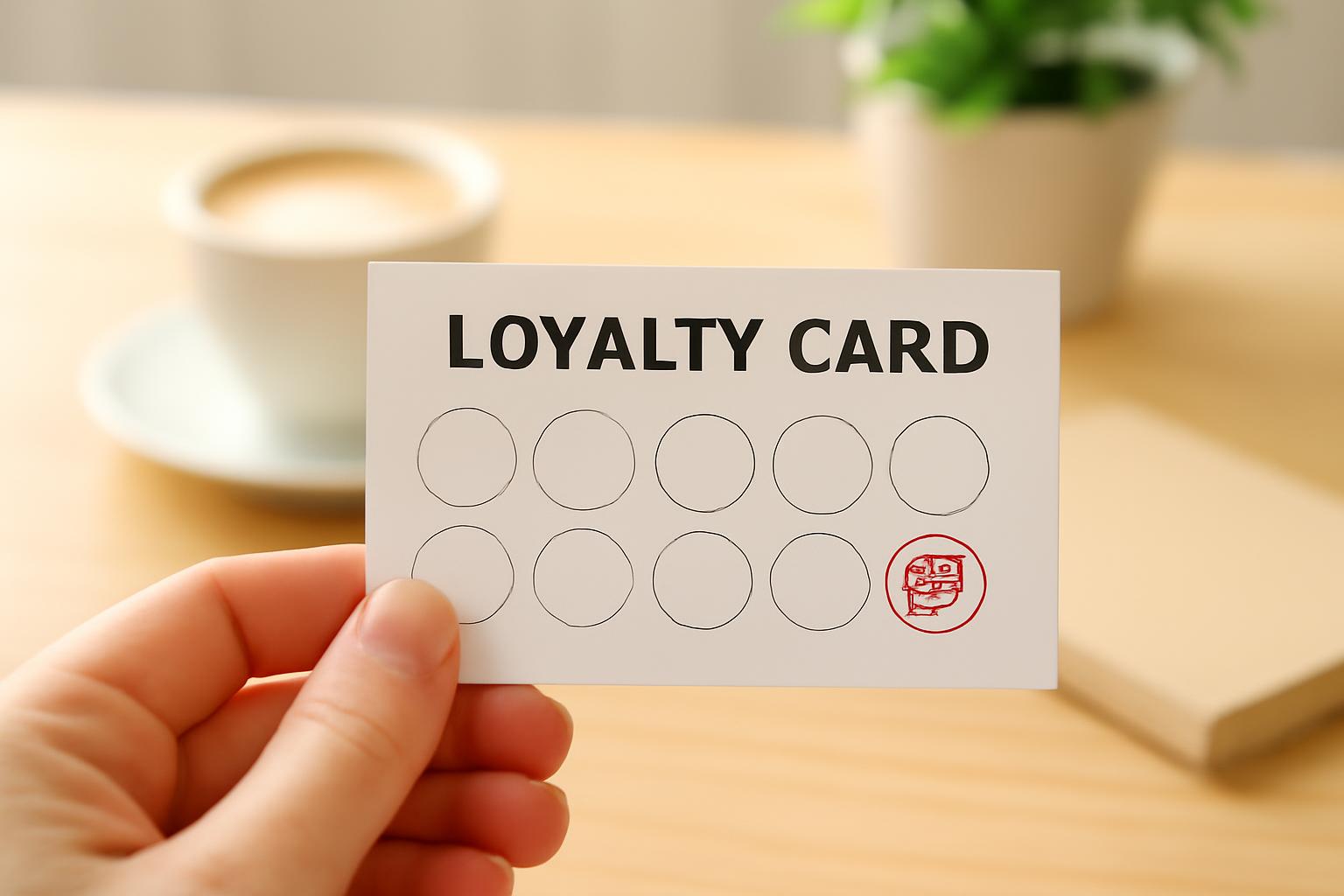
A paper-based loyalty program is a physical card that gets stamped or punched each time a customer makes a qualifying purchase; once the card is full, the customer trades it for a reward. It can be a rational choice for a simple, frequent repeat-purchase offer, but the right format for your business depends on how much you need customer data, messaging, and centralized records.
The mechanic is deliberately basic. RewardStamp describes traditional programs as paper or plastic cards that are stamped or punched every time a customer buys from you. BonusQR gives the canonical example: “Buy 7 coffees, get the 8th one free.” The customer carries the card, your staff mark it at the counter, and the reward threshold is visible on the card itself.
This guide treats the format decision as open rather than settled. Most published comparisons come from digital loyalty vendors, so they lean toward migration. The honest position is narrower: paper has real strengths (low setup friction, no technology requirement for the customer), real limits (loss, misuse, no customer-level data), and no independent like-for-like evidence proving that either format produces better business results. What follows gives you the mechanics, a decision matrix, reward math you can run with your own numbers, operating policies, and a launch or transition plan.
When a paper loyalty card is a good fit
A paper card fits best when your product is bought often, your reward rule fits in one sentence, and you do not need per-customer tracking to run the offer. If those three conditions hold, the format’s simplicity is a feature, not a compromise.
The startup barrier is genuinely low. CuppaCard, a digital vendor with no incentive to flatter paper, concedes the point directly: “Paper’s one real argument is that it is cheap to start. A ream of card and a rubber stamp, and you are away.” There is no platform to evaluate, no subscription to commit to, no staff software training, and no enrollment step for the customer beyond accepting a card.
The fit depends on purchase frequency more than anything else. BonusQR notes that simple stamp systems “work great for businesses with products or services that people buy often,” naming coffee shops, pizza places, hair salons, gyms, and car washes as typical examples. The reasoning is mechanical: the more often a customer can earn a stamp, the sooner the reward feels reachable, and a reward that feels reachable is the whole point of the card.
Familiarity is a real but audience-dependent advantage. A BonusQR comparison of cafe loyalty formats describes paper as familiar for older patrons while noting that digital systems may intimidate non-tech users. That cuts both ways. A paper card excludes nobody on technology grounds, which matters if a meaningful share of your customers do not carry smartphones or do not want another app. But do not assume every audience prefers paper; some customers find physical cards easy to lose and would rather have the record on their phone. Treat familiarity as a property of your specific customer base, something you can test with a pilot, not a universal fact.
The practical limitations of paper punch cards
The core weakness of a paper program is that the card is the entire system. If the card disappears, the customer’s progress disappears, and the business has no backup record and no way to see what happened.
The customer-side problems are well documented across sources. Stampet states that cards are “easily lost, damaged, or forgotten before customers reach their reward,” and MagicStamp lists loss and forgetfulness as long-standing limitations of the format. Loopy Loyalty’s comparison article cites a Statista figure that 39% of customers abandon paper loyalty programs because they misplace their cards. Treat that number as a vendor-cited statistic rather than a benchmark for your business, but the direction of the problem is consistent everywhere: some fraction of issued cards will never come back.
The business-side problems fall into three groups:
- Recurring printing. CuppaCard describes the pattern: you print a batch, run out, and reprint, and a logo change can make the remaining stock obsolete. The upfront cost is low, but it repeats.
- Misuse. Stampet notes that misuse is difficult to track and manage, and MagicStamp points out that paper cards can be forged. A rubber stamp is not a security device.
- No customer-level data. CuppaCard puts it bluntly: a paper punch card tells you nothing about your customers, not their names, not their visit frequency, not whether they stopped coming three months ago.
None of the supplied sources quantifies what these limitations cost a typical business in lost revenue or administration time, so do not let a vendor’s framing convert a real but unmeasured weakness into a precise dollar figure. The correct response is to price the exposure for your own operation: how many rewards you could afford to give away to forged or disputed cards before the program stops making sense, and whether you actually need customer-level data to run your marketing.
Choose between paper, digital, and a temporary hybrid
The format decision comes down to six practical dimensions: setup friction, dependence on a physical card, customer data, messaging capability, customer choice, and what the rollout demands of your staff and customers. No supplied source provides independent evidence that one format wins on total cost or business results across all businesses, so the matrix below sticks to what the evidence supports.
| Dimension | Paper card | Digital program | Temporary hybrid (both) |
|---|---|---|---|
| Setup friction | Lowest; cards and a stamp (CuppaCard) | Platform selection, account setup, staff workflow change | Highest during overlap; two systems run at once |
| Physical-card dependence | Total; lost card means lost progress (Stampet) | None; progress tracked automatically (CuppaCard) | Split by customer choice |
| Customer data | None at the individual level | Visit, stamp, and reward records per customer (CuppaCard) | Partial; only digital participants generate records |
| Messaging | Not possible through the card | Push notifications or SMS on some platforms (Stamp Me) | Digital participants only |
| Customer choice | Works for everyone, including non-smartphone customers | May intimidate non-tech users (BonusQR) | Preserves choice during transition (BonusQR) |
| Rollout demand | Minimal training; staff stamp cards | Staff training plus customer enrollment help | Dual-system handling plus a defined end date |
Read the matrix as a fit test, not a scorecard. If you run a single location, your reward rule is simple, and you have no plan to message customers, paper’s weaknesses may cost you little. If you want to know who your regulars are and reach them between visits, paper cannot do that job at any price. The hybrid row exists because BonusQR recommends offering both paper and digital options during an initial implementation phase; it is a transition tool with a planned end, not a permanent third format, because running two systems doubles the operating rules your staff must apply consistently.
Digital loyalty formats are not all the same
Choosing digital does not automatically mean forcing customers to download an app. The supplied sources describe at least four distinct workflows, and they place different demands on your customers and your counter.
A dedicated app stores stamps in the customer’s own installed application; MagicStamp describes digital stamps stored safely in the customer’s app. A mobile-wallet card skips the download entirely: CuppaCard explains that customers scan a QR code and the loyalty card drops straight into Apple or Google Wallet, “no app, no download.” QR-based enrollment can also feed a platform-managed card, which is the model Loopy Loyalty uses, combining card design, enrollment, stamping, messaging, and reporting in one dashboard. Finally, some providers use dedicated hardware: Stamp Me offers a countertop StampPod that works with tap-and-go technology, so the customer taps rather than scans.
The checkout implications differ. A wallet card asks the customer for one QR scan at enrollment and nothing afterward that a phone screen cannot handle. A tap device adds hardware to your counter but keeps the stamping gesture close to the paper habit. An app gives the provider the richest engagement channel but adds a download step that some customers will refuse. Do not assume every provider supports every route; when you evaluate platforms, ask specifically which enrollment and stamping workflows they support, because that choice determines how much friction your customers actually face at the till.
Compare cost and business evidence without false precision
The honest cost answer is that the supplied figures are vendor estimates, they conflict with each other, and neither settles the question without your local inputs. Start by separating upfront price from recurring cost, then run your own break-even arithmetic.
For paper, Revio, itself a digital vendor, estimates $20-50 for printing 500 cards, $5-15 for a stamp or punch tool, and $10-30 per year in reprints for lost or damaged cards, for a total annual cost of $35-95. For digital, the same source puts most small-business platforms at $19-49 per month, with the full range running $0-200 per month and some platforms charging additional per-customer fees on top of the monthly subscription. As an illustrative comparison, taking $19 per month, the low end of Revio’s typical small-business spending range, $19 × 12 = $228 per year against Revio’s high-end paper figure of $95 per year puts digital at roughly 2.4 times the direct spend, though Revio’s full digital range starts at $0 per month. CuppaCard argues the opposite, that digital “tends to win on cost” once recurring printing is counted. Both are vendor claims; neither includes your staff time, training, or administration, and no supplied source prices those.
The business-results evidence is thinner still. Stamp Me reports a 15-30% increase in customer retention, but the source is its own 2024 merchant survey. Loopy Loyalty’s article describes a single cafe case study with 30% more repeat customers in 60 days. These are vendor-reported outcomes from self-selected businesses, not controlled comparisons. No supplied source offers independent, like-for-like data on enrollment, redemption, retention, or incremental profit between formats. Price both options with local quotes, add your own labor estimate, and treat any ROI projection as a scenario you built, not a fact you found.
Design the earning and reward rules
Whichever format you choose, the design rules are the same: pick a frequently purchased product, set a threshold customers can actually reach, and keep the rule short enough that staff and customers can repeat it without thinking. A program cannot compensate for an offer nobody buys often or a reward nobody expects to earn.
BonusQR makes frequency the first filter: pick a product customers already buy from you frequently, because the faster they earn stamps, the faster the reward arrives. The same source gives a clarity test worth adopting verbatim: “If your reward rules need more than one sentence to explain, it’s too complicated.” Stampet adds the sequencing principle: the best programs “start with a clear, simple mechanic and iterate,” rather than launching every idea at once. One product, one threshold, one reward. You can expand later once the basic loop works.
Choose what earns a stamp
You have three earning triggers to choose from: one stamp per visit, one stamp per qualifying item, or one stamp per amount spent. The right choice depends on how your transactions actually look, not on which trigger sounds most generous.
Per-item earning fits businesses where one product dominates. The BonusQR coffee example, buy 7 and get the 8th free, is per-item earning: every qualifying coffee is a stamp, and the rule verifies itself because the staff member can see the coffee on the counter. Per-visit earning fits services where the transaction is the unit, such as a haircut or a car wash; it also caps the earn rate at one stamp per trip, which protects you if customers buy multiple qualifying items at once. Spend-based earning, one stamp per defined spend amount, fits businesses with highly variable baskets, but it forces staff to check a receipt total rather than glance at a product, which adds a verification step at every transaction.
Run each candidate rule through three checks. First, frequency: can a typical regular earn a stamp on most visits? Second, verification: can a busy staff member confirm eligibility in under five seconds without a judgment call? Third, the one-sentence test from BonusQR: if the trigger needs qualifiers (“except promotions, excluding small sizes, minimum spend applies”), it will be applied inconsistently at the counter, and inconsistency is what breaks trust in a stamp program. Pick the trigger that survives all three, even if a cleverer rule looks better on paper.
Check reward economics with your own inputs
Before you print a single card, check that a fully redeemed card is affordable. This is arithmetic you can do in two minutes with four inputs: the qualifying purchase price, the stamp threshold, what the reward costs you to provide, and a redemption scenario you choose yourself.
BonusQR offers one guideline: the free reward should be worth about 15% of the total spend needed to earn it. You can test any proposed card against that in one line. Take a buy-7-get-the-8th-free offer on a $4.00 coffee. Qualifying spend is 7 × $4.00 = $28.00, the reward’s retail value is $4.00, and $4.00 ÷ $28.00 = 14.3% of qualifying spend, close to the BonusQR guideline. Note that this uses the reward’s retail price; your actual cost is your cost of goods for that item, which only you know, and using it instead gives you the true margin impact per completed card.
Then build a redemption scenario, clearly labeled as your own assumption. If you issue 500 cards and assume, as a planning input, that 40% are ever completed, you are budgeting for 500 × 0.40 = 200 free rewards. At a $1.20 cost of goods per reward, that is 200 × $1.20 = $240 in reward cost against the qualifying revenue those cards generated. No supplied source publishes an evidence-based redemption rate for paper cards, so treat any completion percentage as an input you will replace with your own data after launch. The point of the exercise is not precision; it is making sure an attractive-sounding reward cannot quietly become a threshold you cannot afford at scale.
Set operating policies before launch
Decide your edge-case rules before the first card goes out, because the alternative is staff improvising different answers to the same question in front of customers. The supplied evidence establishes why these cases matter: Stampet confirms that cards are easily lost or damaged and that misuse is difficult to track, and MagicStamp notes that paper cards can be forged. No source validates a universal set of policy answers, so treat the following as a framework you fill in for your own risk tolerance.
Settle these six questions in writing:
- Lost cards. Decide whether progress is replaceable (it usually cannot be verified) and say so on the card itself.
- Combined cards. Decide whether customers can merge two partial cards into one, and whether households can share a card.
- Expiration. Decide whether cards expire, and print the date or the “no expiry” promise on the card.
- Disputed stamps. Give staff one default (“when in doubt, stamp it”) so a $0.50 dispute never costs you a regular customer.
- Suspected forgery. Decide what staff do when a card looks wrong: honor it once and pull the card, or escalate to a manager, but never accuse a customer at the counter.
- Reward accounting. Record every redeemed card so free items do not disappear into till noise; collect completed cards rather than handing them back.
Print the material terms, threshold, expiry, and one-card-per-customer rules directly on the card, and apply them the same way every shift. A paper program’s credibility is enforced entirely at the counter, so consistency is the control. Simple design choices also reduce forgery exposure without new cost: a distinctive stamp rather than a generic one, and collecting cards at redemption so a completed card cannot circulate twice.
Measure a paper program with aggregate records
You cannot get customer-level insight from paper, but you can get aggregate program health from four counts your till already produces or can produce with minimal effort. CuppaCard is right that the card itself tells you nothing about individual customers; the workaround is to measure the program, not the person.
Track cards issued per period, stamps given (or qualifying transactions, if you ring the qualifying item separately), rewards redeemed, and the cost of redeemed rewards at your cost of goods. From those four counts you can compute a completion rate (redeemed cards ÷ issued cards), a reward cost ratio (reward cost ÷ qualifying revenue), and a trend line for each. If you issue 200 cards in a quarter and redeem 50, your observed completion rate is 50 ÷ 200 = 25%, which becomes the real input that replaces the planning assumption from your reward-economics check.
Be clear about what these numbers cannot do. Aggregate counts do not tell you whether the program caused any repeat visit, whether redeemers would have returned anyway, or which customers went quiet; Stampet is correct that paper gives no insight into who your best customers are. Aggregate measurement answers a narrower but still useful question: is the program’s cost staying inside the budget you set, and is participation rising or falling? If you need attribution at the customer level, that is a reason to consider digital, not a metric you can extract from a stamp count.
Launch, test, or transition the program
Launch small, with a defined review point, rather than committing the whole business to an untested mechanic. BonusQR recommends small-scale pilot tests with select customer groups to surface implementation problems before full deployment, and that advice applies equally to a first paper program, a digital replacement, or a hybrid transition.
Before the first card or QR code reaches a customer, work through this checklist:
- Staff explanation. Every person on the counter can state the earning rule and the reward in one sentence and knows the answers to the six operating-policy questions above.
- Customer communication. The rule is visible at the point of sale, and Loopy Loyalty’s guidance on promoting through QR codes, receipts, and social channels applies whichever format you run.
- Redemption handling. Staff know how to verify, record, and retire a completed card or digital reward.
- Pilot scope. A defined group, location, or time window, per BonusQR’s pilot recommendation, rather than an all-customers launch.
- Review point. A date on which you compare issued, completed, and redeemed counts against your planning assumptions and decide to continue, adjust, or stop.
Set the review point before launch, not after, because a program without a scheduled decision date tends to drift. If the pilot numbers match your reward-economics scenario, scale up. If completion is far below your assumption, the threshold is probably too high or the earning trigger too rare, and the pilot has done its job by telling you cheaply.
Preserve customer choice and handle data responsibly
If you move from paper to digital, run both formats for a defined overlap period so no customer loses access on technology grounds. BonusQR recommends exactly this gradual dual-system rollout during the initial implementation phase, noting that digital systems may intimidate non-tech users while paper remains familiar to older patrons. Customers without smartphones, or who simply decline the digital option, should be able to finish existing cards and, if you choose, keep earning on paper until the overlap ends on a date you announce in advance.
Collecting customer data creates obligations that a paper card never did. The same BonusQR source states that transparency about data collection and privacy is paramount for customer trust. As a concrete jurisdictional example, the UK Information Commissioner’s Office guidance on direct marketing states that you must have a lawful basis under data protection law to use people’s information for direct marketing, that consent and legitimate interests are the two bases most likely to apply, and that the Privacy and Electronic Communications Regulations 2003 (PECR) can require consent for some channels, including electronic mail marketing to individual subscribers. That is UK law; if you operate elsewhere, check the rules that apply in your jurisdiction rather than assuming these transfer.
Keep loyalty participation and marketing consent as separate decisions. A customer who joins your stamp program has agreed to collect stamps, not necessarily to receive promotional messages, and platform tooling should support that separation; Loopy Loyalty, for example, states that you can export or delete customer data at any time and remove customers who no longer wish to participate. When you evaluate any provider, confirm you can honor an opt-out and a deletion request without a support ticket.
Avoid predictable rollout failures
Most loyalty rollouts fail at the counter, not in the planning document, so design your pilot to detect counter-level problems specifically. The supplied evidence supports the controls; the failure modes themselves are the practical risks the pilot exists to test.
Watch for four patterns during the pilot:
- Unclear rules. Customers or staff ask what qualifies. The fix is the BonusQR one-sentence test applied ruthlessly.
- Inconsistent staff handling. Two staff members answer the same edge case differently. The fix is the written operating policies, retrained.
- Customer resistance. Enrollment or uptake stalls, particularly among the non-tech users BonusQR identifies as at risk in a digital move. The dual-system overlap is the mitigation.
- Poor workflow fit. Stamping or scanning slows the queue at peak times. If the mechanic adds seconds you cannot afford at your busiest hour, change the mechanic, not the hour.
The structural controls are the ones the evidence backs: pilot with a small group before full deployment, per BonusQR, and start with one clear, simple mechanic and iterate from observed data, per Stampet. Neither control eliminates implementation risk; both make failures cheap and visible early, which is the most any rollout plan can honestly promise. If the pilot surfaces one of these four patterns, fix it and re-test before scaling, because problems that survive a 50-customer pilot do not shrink when you multiply the customer count.