 ExSpade
How to Choose an Enjoyable, Accessible Card Game for an Older Adult
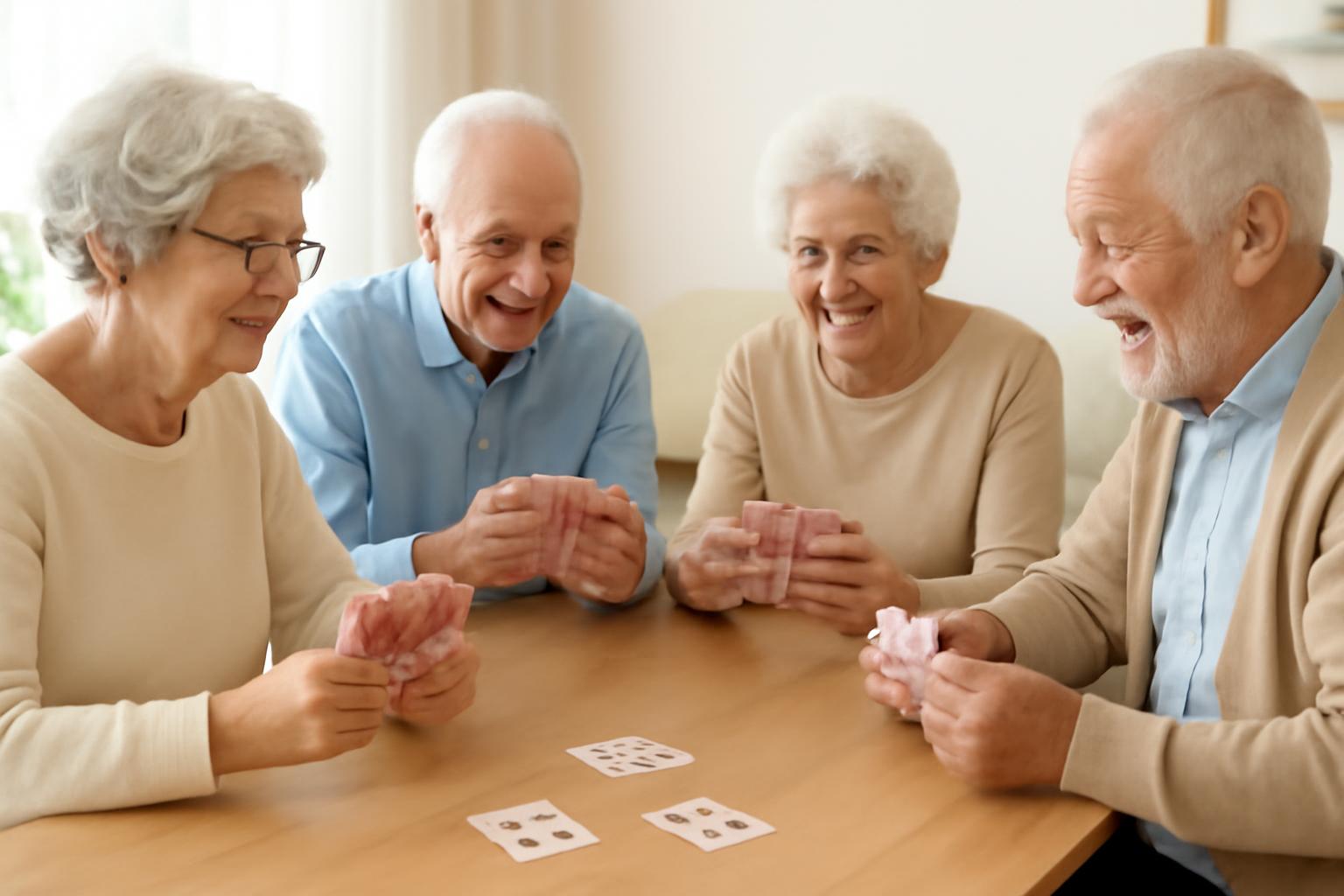
This guide compares 15 card games for older adults, from simple matching activities to Bridge and Canasta. The best choice, however, is not determined by age or by a generic “easy games” label. It depends on what the player knows, enjoys, can comfortably manage, and wants from the experience.
Choose for the person, not the age
Older adults are not a single ability group. A lifelong Bridge or Canasta player may be happier—and more comfortable—playing a familiar strategic game than learning an unfamiliar activity marketed as easy. Conversely, someone new to cards may prefer a repeated one-step matching game even without significant physical or cognitive limitations.
Before choosing, consider:
- Prior experience: Which games has the person played before?
- Preferred activity: Do they enjoy matching, collecting sets, sequencing, predicting, bluffing, or strategic partnerships?
- Player count: Will this be solo recreation, a two-person visit, or a group activity?
- Competition: Do they enjoy keeping score, friendly rivalry, teamwork, or play without winners?
- Vision: Can they distinguish ranks, suits, symbols, and colors at the expected distance?
- Hand function: Can they comfortably draw, hold, fan, and place the cards?
- Attention: How many steps can a turn include without becoming tiring?
- Memory: Must the player remember hidden cards, bids, changing rules, or previous actions?
- Reading and arithmetic: Does play require reading instructions, totaling points, or comparing several values?
- Color recognition: Can the cards be identified without relying on color alone?
- Pace: Can everyone take an unhurried turn, or does the game reward rapid responses?
It also helps to distinguish among three settings. Independent recreation should be something the player can set up and enjoy with little assistance. Facilitated group play may include demonstrations, prompts, scorekeeping help, or equipment management. Activities for someone experiencing cognitive impairment may require more visible information, fewer rules, cooperative formats, or an alternative to conventional play. One list cannot adequately cover all three settings without adaptation.
Begin with a game the person recognizes, or offer a brief trial round before keeping score. Look beyond technical success. Does the player seem interested? Are the cards comfortable to handle? Can the person make meaningful choices? Are mistakes easy to recover from? A game is not a good fit merely because someone can complete it with constant correction.
Simplifying play should mean removing barriers, not treating an adult like a child. A visible hand, shorter deck, card holder, partner, or no-score format may preserve the interesting decision while reducing unnecessary strain. Ask before helping and let the player decide whether a change is useful.
Card play can be presented honestly as recreation, conversation, and enjoyable mental engagement. It may involve matching, sequencing, turn-taking, arithmetic, planning, or strategy. Those features do not establish that ordinary card games prevent dementia, delay cognitive decline, or provide therapy. A retirement-community overview similarly says that games cannot prevent dementia while suggesting practical options such as larger cards and holders (SWFL Retirement’s card-game overview).
Quick selector: match the game to the players and the desired challenge
The following is a practical selector, not a clinically validated difficulty ranking. “Rules burden” is an editorial judgment based on the number of turn steps, changing conditions, scoring requirements, hidden information, and conventions a new player may need to manage. Familiarity can change that burden dramatically.
Rounds may be short or extended depending on house rules, player count, pace, scoring, and adaptations. Instead of relying on a promised playing time, decide whether the group can stop after a hand, deal, shared target, or another natural break.
| Game | Usual play format | Core action | Relative rules burden | Notable demands | Competition or cooperation | Easy adaptations to try |
|---|---|---|---|---|---|---|
| Solitaire | Solo | Build and rearrange sequences | Middle | Visual scanning, sequencing, card movement | Individual challenge; another person can offer hints | Use fewer piles, turn more cards face up, or use a holder |
| Higher or Lower | One-to-one or group | Predict whether the next card is higher or lower | Low | Value comparison and a rule for ties | Individual scores, collective guesses, or no score | Remove face cards, reduce the deck, display the sequence |
| War | Pair; adaptable for a group | Reveal and compare cards | Low | Value recognition and repeated handling | Competitive or partner-assisted | Use a smaller deck, stop after a short round, or let a facilitator turn cards |
| Matching Pairs | Solo, pairs, or group | Locate matching cards | Low | Visual matching; memory when cards are face down | Competitive, shared search, or no score | Use fewer cards, leave them face up, or use familiar pictures |
| Go Fish | Small group | Ask for ranks and collect matches | Low | Turn-taking, rank recognition, some memory | Competitive or open-hand cooperative play | Collect pairs, reduce the ranks, show hands, offer prompts |
| Old Maid | Small group | Make pairs and avoid the unmatched card | Low | Matching and drawing from another hand | Usually competitive; can be played without scoring | Reduce the deck, use visible hands, make the unmatched card clear |
| Crazy Eights | Small group | Match the discard by rank or suit | Middle | Hand management and a wild-card rule | Competitive or partner-supported | Open hands, prompts, color matching, or a simpler rule for eights |
| UNO | Small group | Match by number, color, or symbol and shed cards | Middle | Symbols, colors, action cards, changing conditions | Competitive; partners or shared decisions are possible | Use smaller hands, visible cards, fewer action cards, spoken identification |
| Gin Rummy | Pair | Form sets and runs while drawing and discarding | Middle to high | Planning, hand management, optional scoring | Competitive; open-hand teaching is possible | Ignore scoring initially, reveal hands, use a combination guide |
| Rummy | Pair or group | Form sets and runs | Middle | Pattern recognition, planning, optional scoring | Competitive or partner-assisted | Simplify scoring, reduce the hand, display valid examples |
| Skip-Bo | Individual or team play | Build numerical sequences | Middle | Sequencing, several piles, planning | Competitive or team-based | Reduce stock piles, use partners, label play areas |
| Hearts | Group | Take tricks while generally avoiding penalty cards | High for beginners | Trick-taking, card tracking, scoring, strategy | Competitive; teaching hands can be open | Use a scorekeeper, reference sheet, or visible practice hand |
| Canasta | Partnership play | Build melds and manage a shared score | High | Multiple decks, partnership decisions, meld rules, scoring | Team competition | Preserve familiar house rules, add turn reminders, simplify scoring |
| Cribbage | Commonly a pair game | Form combinations and move pegs on a board | High for beginners | Arithmetic, combination recognition, several scoring stages | Competitive; another person can help total points | Use a scoring reference, larger board, or designated scorekeeper |
| Bridge | Partnership table | Bid and play tricks with a partner | High for newcomers | Conventions, inference, memory, partnership strategy | Team competition | Retain familiar conventions, add bidding aids, use open teaching hands |
Go Fish, War, Old Maid, Matching Pairs, and Higher or Lower are reasonable lower-rule-burden starting points. Crazy Eights, UNO, Rummy, and Skip-Bo add hand management, sequencing, or changing play conditions. Hearts, Canasta, Cribbage, and Bridge may require more scoring, strategy, partnership coordination, or multi-step conventions.
That does not make advanced games unsuitable for older adults. Gin Rummy is typically played by two people, while Rummy commonly supports two to six players (Christwood’s Rummy and Gin Rummy guide). Bridge is conventionally a four-player partnership game, but its demands will feel very different to a newcomer and to someone who has played for decades (Eden Vista’s comparison of classic games).
Six approachable games using a standard deck
These concise versions are starting points, not definitive official rules. Traditional rules vary by household, region, source, and named variant. Agree on unusual situations—especially ties, scoring, drawing, and wild cards—before beginning.
Go Fish. Deal a small hand to each player and place the remaining cards in a draw pile. On a turn, ask another player for a rank already represented in your hand. If that player has a card of that rank, it is handed over; otherwise, draw from the pile. For an approachable version, collect pairs rather than four-card books.
To reduce memory demands, use only part of the deck, leave hands face up, or let players ask what ranks are available. Open hands change the activity from remembering hidden information to recognizing and requesting matches. A facilitator can offer a choice—“Would you like to ask for a four or a king?”—without choosing for the player.
War. Divide the chosen cards between two players. Each reveals the top card, and the higher card takes the pair. Continue only while the players remain interested rather than insisting that the entire deck be won.
A smaller deck or agreed stopping point can prevent repetitive play from becoming tiring. Choose a tie procedure in advance: reveal one additional card, follow the household’s traditional “war” rule, or set tied cards aside. Smaller decks, shorter play, and simplified ties are among the adaptations suggested for people experiencing early cognitive changes (DementiaWho’s adaptable game suggestions).
Old Maid. Remove one card so its matching partner is absent, or designate one clearly recognizable card as the Old Maid. Deal the cards, let players place their existing pairs on the table, and take turns drawing from a neighbor’s hand. Place each new pair down. The conventional aim is to avoid finishing with the unmatched card.
If holding a large fan is difficult, use a card holder or place cards upright behind a screen. For lower-pressure play, treat the final reveal as a humorous ending rather than a loss and do not keep cumulative scores.
Crazy Eights. Place one card face up as the discard pile. Players take turns playing a card that matches its rank or suit. An eight acts as a wild card and allows the player to choose the next suit. If no card can be played, draw according to the agreed house rule.
Possible changes include keeping hands visible, allowing prompts, matching by color instead of suit, or treating an eight as a simple “play on anything” card without requiring a suit choice. Color matching may lower one demand while creating another for someone who has difficulty distinguishing colors, so retain visible number or suit cues.
Matching Pairs. Select pairs of identical ranks or pictures, shuffle them, and arrange them face down. A player turns over two cards. A match is kept or left visible; a nonmatch is turned back over. Continue until all pairs have been found.
Memory is only one possible feature of the activity. Use fewer cards to reduce the search field, leave every card face up for a visual-matching task, or use familiar pictures instead of playing-card ranks. Players can search together rather than compete. If face-down play causes repeated frustration, changing to face-up matching is an adaptation, not a failure.
Higher or Lower. Place one card face up and ask whether the next card will be higher or lower. Reveal the next card and use it as the reference for the following prediction. Play can be one-to-one, passed around a group, or conducted as a collective guess.
Scoring is optional. Count correct predictions, aim for a shared streak, or simply reveal cards and discuss the result. Remove face cards or use a smaller range if comparison is difficult. The supplied activity rules count aces as one but do not say what happens when equal-value cards appear, so choose a house rule: call a tie neutral, count it as an incorrect prediction, or offer “same” as a third choice. The activity source also suggests collective guessing, gestures, visible card displays, and unhurried play (Maria’s Place Higher or Lower instructions).
Options for solo play, pairs, teams, and strategy-minded groups
Solitaire is the clearest conventional choice for independent play. In familiar Klondike-style Solitaire, the player rearranges cards across a tableau while building suit foundations in sequence. That is only one form: FreeCell, Pyramid, and other variants create different demands. A person who dislikes managing a physical deck may prefer a digital version, while another may value the tactile routine of laying out cards.
Gin Rummy is typically a two-player game based on forming sets and runs while managing unmatched cards. It suits a pair who enjoys repeated decisions about drawing, keeping, and discarding. Scoring can be postponed during a teaching session so the players can concentrate first on recognizing combinations.
Rummy is a flexible group choice commonly played by two to six people. Players form sets of equal ranks and runs of consecutive cards. Because “Rummy” covers multiple variants, decide how many cards to deal, which melds are valid, whether players may add to existing melds, and how the round is scored. One household’s version should not be presented as a universal rule.
UNO and Crazy Eights are shedding or matching games: players try to use cards that match a visible condition and reduce their hands. They can support lively group play, but accessibility should not be assumed. Players must inspect their hands, identify allowable cards, and respond when action or wild cards alter play. UNO’s color categories can be supplemented by numbers, symbols, or spoken identification; bold colors alone do not make the game accessible to every player.
Skip-Bo centers on constructing numerical piles in order and can also be played in teams (S&S activity guide to Skip-Bo). The personal and shared piles may create visual clutter, so groups can test clearly separated table areas or short labels explaining each pile’s purpose.
Hearts is a trick-taking game in which players generally try to avoid penalty cards and finish with the lowest score. The turn itself may be straightforward for someone familiar with trick-taking, but strategic play involves tracking cards and interpreting other players’ choices. A designated scorekeeper can remove arithmetic work without changing the decisions made in each trick.
Canasta is commonly played as a partnership game centered on forming melds. Common partnership forms use multiple decks and introduce more scoring and rule overhead than the beginner options. For experienced players, those details may be part of the appeal. Preserve familiar house rules rather than simplifying a valued weekly game without asking.
Cribbage combines card combinations with movement on a scoring board. The board makes progress visible, but players still need to recognize and total combinations at several stages. A scoring reference or a person who totals points can reduce the arithmetic burden while leaving card choices with the player.
Bridge is a four-player partnership game with substantial strategy and bidding conventions. It is likely to be demanding for a complete beginner, but that says little about someone who has played for decades. For an established group, bidding aids, convention notes, improved lighting, and an unhurried pace may be more respectful than replacing Bridge with a supposedly age-appropriate matching game.
Complexity is contextual.
Make cards easier to see, hold, hear, and follow
Accessibility is often improved by changing the environment or equipment rather than replacing the game. The following are options to test, not clinically validated solutions for a particular condition.
For visibility, try:
- Large-print or high-contrast cards with clear ranks and suit symbols
- Strong, even lighting
- A plain, uncluttered playing surface
- Cards placed where each participant can comfortably inspect them
- Clear sightlines to the draw, discard, and meld piles
- Comfortable seating and a low-distraction room
Large cards are not automatically better. Card holders, tabletop placement, smaller hands, or assistance with handling may be more practical. Retirement-community guidance commonly suggests large-print cards, holders, good lighting, and fewer distractions, but it does not establish that any accessory is clinically best for a visual or motor condition (SWFL Retirement’s accessibility suggestions).
For arthritis, weak grip, or other handling difficulty, try a holder, deal fewer cards, or let the player place cards face up. A facilitator may shuffle, deal, draw, or move a selected card when asked, while leaving the choice itself with the player. A useful question is: “Would you like me to move the card you choose?”
For limited attention or slower processing:
- Reduce the deck or hand size.
- Demonstrate one turn before asking the player to act.
- State the turn sequence in a short, consistent form.
- Put a simple reminder on the table.
- Slow the pace and allow extra response time.
- Pause between rounds and ask whether the player wants to continue.
When verbal directions are difficult to hear or process, combine speech with gestures or visible examples. Point to the draw pile while saying “draw one.” Place an example pair on the table while explaining matching. The Higher or Lower activity guidance similarly recommends clear repetition, up-and-down gestures, visible cards, and unhurried play (Maria’s Place accessibility suggestions).
Do not rely on color as the only cue. This is especially relevant to UNO and color-based adaptations of Crazy Eights. Make sure numbers, suit marks, patterns, or action symbols remain identifiable, and say the relevant feature aloud when useful.
Test one change at a time. If larger cards improve visibility but become difficult to hold, the group needs to recognize the trade-off. Try a holder, different lighting, or a smaller hand separately rather than changing every element at once.
Adapt card activities for cognitive impairment without removing dignity
Suggestions based on dementia stages should be treated as flexible starting points, not prescriptions. Interests, symptoms, vision, language, attention, memory, and tolerance vary among individuals and may change from day to day. A diagnosis or stage label cannot determine the right game by itself.
For early cognitive changes, begin with a familiar game such as Rummy or Crazy Eights. Slow the pace, keep hands visible, reduce the deck, give brief prompts, and simplify or delegate scoring. Caregiving guidance for early cognitive changes emphasizes familiar games, visible information, fewer cards, slower turns, and stopping or changing the activity if frustration develops (DementiaWho’s early-stage suggestions).
When memory or attention difficulties are greater, try repetitive formats with immediately visible choices:
- Face-up Go Fish using pairs
- Short rounds of War
- Matching by number only
- Matching Pairs with a small set
- Cooperative Higher or Lower
- Sorting cards before turning the activity into a game
When rules become overwhelming, conventional winning and scoring are optional. Cards can instead be sorted by color or suit, arranged in numerical sequence, grouped into visible pairs, shuffled, handled, or used to prompt conversation about familiar pictures. A commercial memory-care provider suggests these kinds of sorting, sequencing, matching, and handling activities while stressing that individual comfort should guide the session (Cascade Living’s dementia card-activity guidance).
No-score and shared-goal formats can reduce pressure while retaining choices. The group might search for all four aces, build one sequence together, or make collective Higher or Lower predictions. In partner play, one person can explain the available options while the player selects the card. Collective guessing also allows someone to contribute without holding a full hand.
Prompt respectfully:
- Demonstrate the action once.
- Offer a manageable choice rather than an open-ended test.
- Allow time for a response.
- Repeat or rephrase without criticism.
- Accept harmless variations when strict correction adds nothing.
- Praise participation naturally, without using a childish tone.
For example, “You can match this seven or this heart. Which would you like?” is more supportive than repeatedly asking, “Don’t you remember the rule?” Avoid quizzing the person about rules they have forgotten or discussing mistakes as if they are not present.
Simplify, pause, or end the activity if the person appears tired, agitated, confused, frustrated, or embarrassed. These signs do not prove a medical problem, but they are practical reasons to check in rather than insist on finishing. A neutral transition—“Let’s have some tea” or “We can finish another day”—allows the session to end without announcing failure.
One discontinued product, I Got It!, illustrates design ideas rather than offering a current buying recommendation. Its retailer described large cards, visible cues, short hands, and a simplified number-only matching format, but marked the product discontinued and provided no clinical validation (archived retailer page for I Got It!). Similar concepts can be tried with a standard deck by dealing a few cards face up and matching by rank alone.
Plan a relaxed family visit or senior-living card session
Begin by asking participants what they already know and want. Some may prefer Solitaire in a quiet corner. Others may want partners, conversation, light competition, or serious strategy. A successful event does not require every person to play the same game.
Set up several choices:
- A face-up matching or Higher or Lower table
- A Go Fish, War, or Old Maid table
- A Crazy Eights or UNO table
- A Rummy or Skip-Bo table
- A familiar advanced-game table for Hearts, Canasta, Cribbage, or Bridge
- A quiet solo area for Solitaire
Provide standard decks, large-print options, card holders, score pads, pencils, and brief rule reminders. Use well-lit tables with comfortable seats, clear sightlines, and enough room for cards, holders, and shared piles. Offer a quieter area for anyone who finds background conversation distracting.
Before scoring begins, demonstrate one round. Keep the central sequence visible—for example, draw, play or meld, discard. A practice hand lets people ask questions without feeling that an error has affected the result.
Allow participants to observe, join late, change tables, use a partner, or leave without penalty. Someone who initially declines may join after watching. Someone who enjoys the first round may still want a break before the second.
A flexible session can follow this pattern:
- Welcome participants and describe the choices.
- Help each person select a table.
- Demonstrate a short practice round.
- Play one or more manageable rounds.
- Offer an optional break.
- Ask whether the group wants to continue, switch, or stop.
One dementia-oriented senior-living source suggests about 15 to 30 minutes as a starting session range, while also advising that play end earlier if fatigue or agitation appears; this is not a universal or clinical limit (Cascade Living’s session guidance). One person may enjoy only several turns, while another may remain comfortable much longer. Use interest and comfort, not the clock alone, to decide when to finish.
For recurring programs, introduce no more than one unfamiliar game at a time while retaining known favorites. This adds novelty without turning every session into a lesson. Keep prizes optional and modest so conversation, participation, and freedom of choice do not become secondary to winning.
What card games can—and cannot—be claimed to do
Card games have observable activity features. They can involve turn-taking, matching, sequencing, visual searching, conversation, arithmetic, strategy, and shared recreation. A particular game may ask a player to remember hidden information, compare values, plan a discard, or coordinate with a partner.
Those demands do not prove a medical outcome. The commercial senior-living, retailer, caregiving, and activity sources used for practical suggestions in this guide frequently describe possible improvements in memory, dexterity, mood, or brain health without supplying enough information about study design, participants, measurements, comparison groups, or long-term results to establish those effects.
The available evidence does not establish that ordinary recreational card games prevent dementia, delay cognitive decline, reliably improve memory as a medical outcome, or function as therapy. It is reasonable to say that players are matching, planning, conversing, or enjoying themselves when those things are directly observable. It is not reasonable to turn those observations into a promise of prevention or treatment.
A cybersecurity card game provides a bounded example of cards being designed for education. The evaluation had a total sample of 16 comprising older adults and digital educators and used a 48-card, A6-sized deck designed for readability and handling. Participants reportedly viewed the gameplay favorably and found the cybersecurity advice useful. The evaluation combined think-aloud playtesting, interviews, and surveys (ACM paper on the cybersafety card game).
That small evaluation did not establish durable behavior change, reduced fraud victimization, or broad effectiveness. Some material was specific to Ireland, and the supplied report did not provide long-term follow-up. Favorable participant perceptions can inform design, but they are not equivalent to evidence of changed real-world safety outcomes.
Recreational card play should also be kept distinct from casino wagering. Poker-style and other casino card games introduce financial risk, not merely social competition. ExSpade describes itself as a gambling-mathematics education site rather than an elder-care or therapeutic service, and advises using only money one can afford to lose and treating gambling as entertainment (ExSpade’s stated mission and responsible-gambling guidance). Casino gambling should not be presented as a recommended cognitive or social activity for older adults.
What are the easiest card games for elderly beginners?
Go Fish using pairs, War, Old Maid, face-up Matching Pairs, and Higher or Lower are useful starting points because each can use a short, repeated turn. Familiarity still matters: a known family game may be easier than any title on a generic beginner list.
Start with a reduced deck, demonstrate a round, and postpone scoring. If the player understands the choice but struggles to hold or remember cards, make the information visible or change the equipment before replacing the game.
What card games can one older adult play alone?
Solitaire is the main conventional solo option. Klondike is familiar to many players, while FreeCell, Pyramid, and other variants offer different structures and levels of difficulty.
Matching Pairs, sorting, sequencing, and Higher or Lower can also be adapted for solo use. A player might arrange cards into suits, build numerical runs, locate visible pairs, or predict each new card without keeping score.
How can cards be made easier to see and hold?
Try large-print or high-contrast cards, strong lighting, an uncluttered surface, and shared cards positioned where they can be comfortably inspected. Ensure that numbers and symbols—not only colors—identify the cards.
For handling, test card holders, smaller hands, face-up tabletop placement, or assistance with shuffling and moving selected cards. Large cards may improve visibility while making gripping or fanning harder, so assess card size and handling separately.
What card games may work for an older adult with dementia?
Begin with a familiar game and adjust it according to the person’s abilities and comfort that day. Possibilities include open-hand Rummy or Crazy Eights, face-up Go Fish, short War rounds, Matching Pairs with fewer cards, number-only matching, and cooperative Higher or Lower.
If rules or scoring become overwhelming, try sorting cards by suit, arranging them in sequence, matching visible pairs, or discussing familiar pictures. Demonstrate rather than quiz, allow time for responses, and pause or stop if the activity is causing visible distress.
Do card games prevent dementia or improve memory?
The supplied evidence does not establish that ordinary card games prevent dementia, delay cognitive decline, or reliably improve memory as a medical outcome. Card games can involve memory, matching, planning, conversation, and other forms of mental engagement, but performing those activities is not proof of prevention or treatment.
Choose card play because the person finds it enjoyable, meaningful, or socially rewarding—not because of an unsupported health promise. Anyone seeking treatment or individualized guidance for cognitive changes should consult an appropriately qualified healthcare professional.
The practical decision path is simple: start with a game the person already recognizes, remove one barrier at a time, and prioritize comfort, choice, and shared enjoyment over strict rules or winning. A standard deck can support everything from sorting and face-up matching to Rummy, Hearts, or Bridge. The right level is the one that remains engaging without creating avoidable strain or embarrassment.