 ExSpade
How to Run a Complete Horse Race With Two Dice
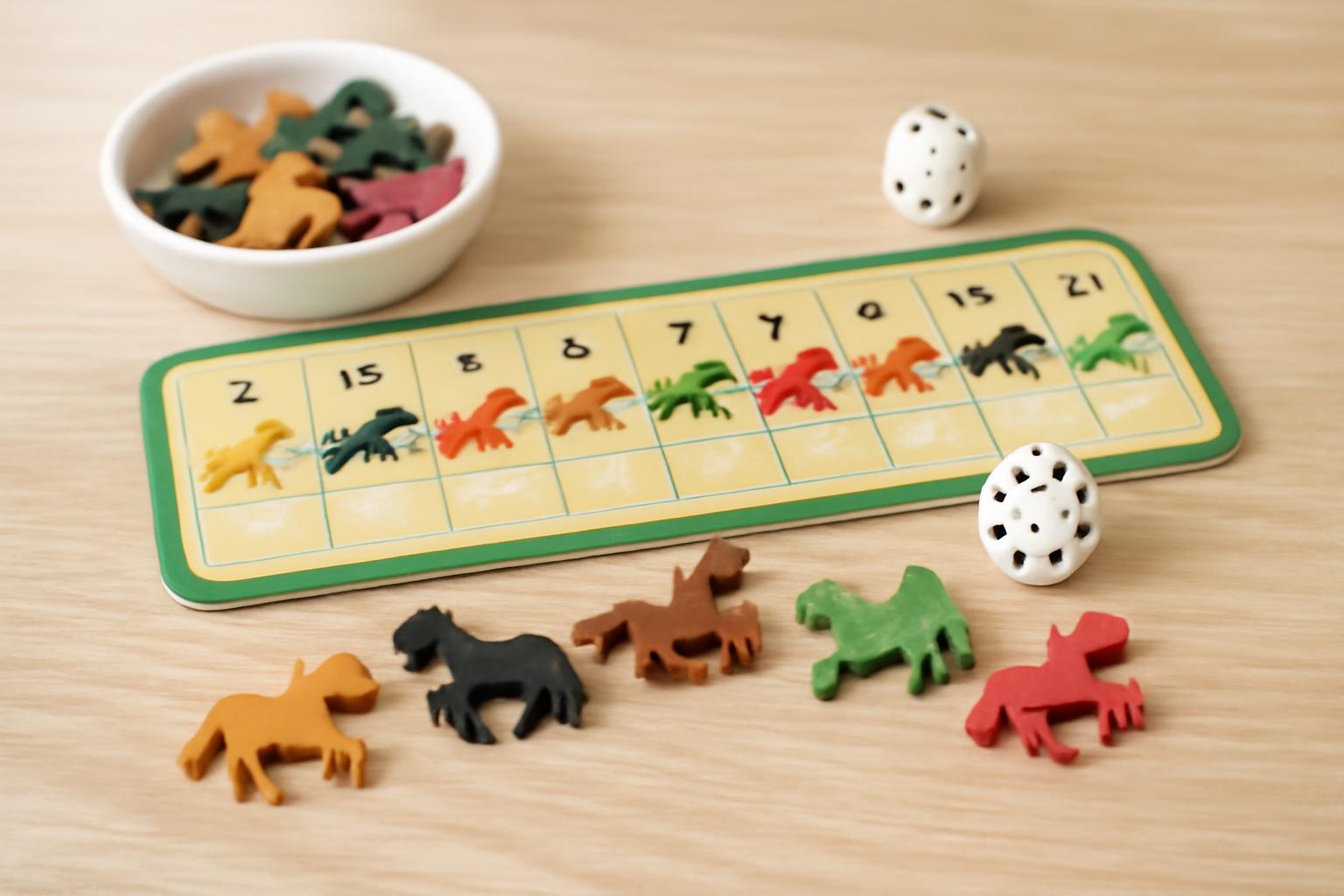
The traditional horses dice game covered here is an 11-horse race. The horses are numbered 2 through 12 because those are the possible totals from two standard six-sided dice. On every roll, add the dice and move the horse bearing that total forward one space.
That central mechanism supports several formats. A printable classroom game may use only a track, counters, and dice. A fuller wooden-board version may add playing cards, scratched horses, chips, and a shared pot. These games belong to the same general family, but there is no verified universal ruleset governing every board.
This guide separates the established core from optional conventions. It provides a quick no-money race, a complete card-and-chip template, house rules for ambiguous situations, and the probability information needed to choose an appropriate track.
First, Identify Which Horse-Racing Dice Game You Mean
- A simple printable race. Players select or predict horses, roll two dice, and move the horse matching the total. The first horse to finish wins.
- A traditional-style wooden race. The same dice mechanism is combined with horse-share cards, scratched horses, chip payments, and a pot.
- Long Shot: The Dice Game. This is a distinct boxed strategy game, not another name for the traditional 2-through-12 race.
The simple version is easy to reproduce on paper. One educational printable has rows numbered 2 through 12 and instructs players to move a counter when the dice equal their selected horse’s number; the first counter to finish wins (see the printable two-dice horse race).
Wooden retail boards commonly preserve that movement rule but add components and procedures. Cards may represent interests in horses, pre-race rolls may remove horses from contention, and later rolls of those scratched numbers may trigger chip payments. Scratch procedures, fees, payouts, and track lengths vary among sets and households. Rules printed for one board should not automatically be treated as binding on another.
Long Shot: The Dice Game is a separate game. It uses eight horses and gives players decisions involving horse purchases, bets, race influence, and special abilities. Three horses must finish before the winner is determined by money (see the publisher’s Long Shot overview). Those mechanisms go well beyond rolling a total and advancing the matching horse.
Where to go next
- For the easiest family or classroom game, use Five-Minute Rules for a Simple, No-Money Race.
- For scratches, cards, chips, and payouts, use Complete Card, Scratch, and Chip Rules.
- To understand why horse 7 is not always favored, see The Dice Math.
- To compare printable, wooden, DIY, and modern strategy formats, see Non-Cash Variants, Strategy Additions, and Other Game Formats.
No verified inventor, origin date, or official governing ruleset is established here. It is more accurate to describe the game as a flexible traditional format built around a shared dice mechanism.
What You Need to Play
The equipment depends on how much structure you want.
Minimum equipment for a simple race
You need:
- Two standard six-sided dice
- A track with lanes numbered 2 through 12
- Eleven horse markers, pawns, or counters
- A clearly marked starting position and finish space for each horse
The markers do not need to look like horses. Coins, buttons, cubes, bottle caps, or printed counters work as long as players can distinguish them.
A printable sheet is the easiest format to improvise. A larger homemade board may be preferable when several people need to follow the race from different sides of a table. One documented DIY project used an approximately 30-by-20-inch board to improve visibility for a group, although the build also required woodworking supplies and specialized equipment. It should not be taken as evidence that a similar board will be inexpensive or easy for everyone to make (view the oversized DIY board).
Additional equipment for the card-and-chip game
Add:
- One standard deck of playing cards
- Equal-value poker chips, counters, tokens, or recorded points
- A central area for the pot
- A written scratch-fee schedule
- A designated dealer
A common horse-share deck contains 44 cards. Prepare it as follows:
- Remove both jokers.
- Remove all four aces.
- Remove all four kings.
- Keep cards 2 through 10 at face value.
- Treat each jack as horse 11.
- Treat each queen as horse 12.
This leaves four cards for each of the 11 horse numbers—one in every suit. Merchant-published instructions document this mapping and the removal of jokers, aces, and kings (review the card and scratch instructions).
The cards are shares or interests, not movement controls. A player holding the queen of hearts does not decide when horse 12 moves. Every active horse moves only when the two dice total its number.
Because four suits represent each horse, several players may hold cards for the same runner. One player may also receive two or more suits of the same horse. The cards determine who shares in the result; the dice determine the race.
Practical setup improvements
The following are practical suggestions, not established game standards:
- Put a visible roll log beside the board.
- Print horse numbers in a large, high-contrast typeface.
- Make lanes visually distinct without relying only on color.
- Give similar-looking markers colored bases, numbered labels, or tactile identifiers.
- Assign one person to announce each total and another to move the horse.
- Place scratch markers directly over eliminated horse numbers.
- Display the payout rule and fee schedule where everyone can see them.
Commercial wooden sets may bundle a board, horses, dice, and cards, although contents and rules vary. A printable board can use ordinary counters, while an oversized DIY board trades portability for visibility. Choose according to table space, group size, and how easily everyone can read the track.
Five-Minute Rules for a Simple, No-Money Race
Use this version for a first game, family activity, or classroom probability demonstration. It has no cards, scratches, pot, or betting.
Setup
- Place all 11 horses at the start of their lanes.
- Confirm that the lanes are numbered 2 through 12.
- Choose the first roller by any neutral method.
- Pass the dice clockwise after each turn.
- Decide whether players will predict winners or simply watch a shared race.
How to race
On your turn:
- Roll both dice.
- Add their values.
- Move the horse matching that total forward one space.
- Pass the dice clockwise.
For example, a roll of 3 and 5 totals 8, so horse 8 advances one space. It does not matter who rolled or which horse that player predicted.
The race ends immediately when an advancing horse reaches its finish space. That horse wins; do not complete the round.
Two ways to participate
Prediction format: Before the race, each player chooses or writes down a predicted winner. More than one player may select the same horse. If correct predictions earn points, declare whether every correct player receives the full reward or whether a fixed reward is divided among them.
Shared-race format: Nobody owns or selects a horse. Players take turns rolling, announce the totals, and watch all 11 runners progress. This works particularly well when the purpose is probability practice rather than competition among players.
Rules for unusual rolls
Use these concise house rules:
- Pass the dice clockwise after every valid roll.
- A horse wins as soon as it enters or reaches its marked finish space.
- Reroll only if a die leaves the agreed rolling area or is visibly cocked.
- Do not reroll merely because someone dislikes the total.
- If a horse is moved incorrectly, correct it when the roll log confirms the error.
Equal lanes are simple, not probability-balanced
An equal-length track is easy to explain, but it strongly favors frequently rolled totals. Horse 7 can be produced by more dice combinations than any other horse, while horses 2 and 12 each have only one producing combination. If every horse must travel the same distance, horse 7 will normally move more often.
That imbalance is useful in a classroom. Keep a tally from 2 through 12, record every roll, and compare the observed totals with the expected two-dice distribution after the race. A short session may be uneven, but repeated races should make the center-heavy distribution easier to recognize.
Possible questions include:
- Which total appeared most often?
- Did horse 7 actually win?
- How many rolls produced 2 or 12?
- How closely did the observed frequencies match the expected distribution?
- How could lane lengths compensate for unequal roll frequencies?
The important distinction is that roll frequency is not certainty. Horse 7 is favored on equal lanes, but it can still lose an individual race.
Complete Card, Scratch, and Chip Rules
The following is a complete, playable template assembled from documented conventions. It is not presented as the game’s single official ruleset. Where published versions disagree or leave a gap, the selected house rule is identified.
1. Prepare the horse-share deck
From a standard deck:
- Remove jokers, aces, and kings.
- Keep cards 2 through 10.
- Use jacks as horse 11.
- Use queens as horse 12.
You now have 44 horse-share cards: four cards for each of the 11 horses.
2. Establish the session rules
Before dealing, agree on:
- Whether chips are points or represent money
- Each player’s starting stack
- The base scratch fee
- Whether scratch fees escalate
- How many races the session will include
- What happens if a player cannot pay
- Whether undealt cards are eligible for payouts
- What happens if the winning horse has no eligible cards
For a family game, use points or valueless chips. Give every player the same fixed starting stack.
Do not wait until someone runs out of chips to decide whether rebuys are permitted. A no-credit, no-rebuy policy is the cleanest choice when equal starting conditions matter.
3. Choose a dealer and deal the cards
Choose a dealer by agreement or a high roll. Shuffle the 44-card horse deck and deal the cards as evenly as possible.
If the cards do not divide evenly, place the leftovers face down. Under this guide’s recommended house rule, undealt cards are inactive and ineligible for payouts. Nobody can claim a share through a card that was never held.
Players may keep their hands private or place cards face up. Face-up play is easier for new groups because everyone can verify scratch payments and winning shares.
4. Select four distinct scratched horses
Beginning with the player to the dealer’s left, roll both dice and scratch the horse matching the total. Mark that horse clearly and reveal, discard, or deactivate every card bearing its number.
Continue until four different horses have been scratched.
If a total repeats during scratch selection, reroll it. This is the template’s chosen house rule so that every race begins with exactly four scratches. Some published procedures instead charge for the repeat and permit fewer than four horses to be scratched, so groups using a packaged set should check its instructions.
5. Pay the initial scratch charges
After each horse is scratched, every player pays the declared charge for each matching card they hold, then discards or deactivates those cards.
You may use one flat charge for all four horses. Alternatively, use escalating charges:
| Scratch order | Charge |
|---|---|
| First scratched horse | 1 × base fee |
| Second scratched horse | 2 × base fee |
| Third scratched horse | 3 × base fee |
| Fourth scratched horse | 4 × base fee |
For example, with a two-point base fee, the four scratch rows would cost 2, 4, 6, and 8 points per affected card. These values illustrate the multiplication rule; they are not universal fees.
Put all scratch payments into the central pot.
6. Start the race
The player to the dealer’s left rolls first. Play then proceeds clockwise.
On each turn:
- Roll both dice.
- Add them.
- If the matching horse is active, move it forward one space.
- If the matching horse is scratched, move no horse. The roller pays that horse’s declared scratch fee into the pot.
- Pass the dice clockwise.
A scratched total rolled during the race is therefore different from a repeated total during scratch selection. During setup, this template rerolls the repeated number. During the race, the roll stands, causes no movement, and triggers the declared payment.
7. End the race
The race ends immediately when an active horse reaches its finish line.
The player who rolls the winning movement does not automatically own the horse or receive a reward. A separate reward for the winning roller applies only if the group declares a jockey bonus before play.
8. Divide the pot
Some published rules state that each card matching the winning horse receives one quarter of the pot. That becomes ambiguous when one or more matching cards were undealt, discarded, or otherwise ineligible.
Use this adaptive house rule instead:
- Count the eligible cards matching the winning horse that players actually hold.
- Divide the entire pot equally by that number.
- Pay one share for each eligible winning card.
If a pot contains 48 chips and three eligible cards match the winner, each card pays 16 chips. A player holding two of those cards receives 32 chips; the holder of the third receives 16.
If chips remain after division, either carry the remainder into the next race or award it by a predeclared method. Do not invent a rounding rule after seeing the winner.
If no eligible card matches the winning horse, carry the entire pot into the next race under this template. For a one-race session, declare a different fallback before dealing—for example, returning contributions proportionally or awarding the pot by a separate prediction contest.
9. Continue or end the session
Before the first deal, select one endpoint:
- One race
- A fixed number of races
- A fixed end time
- Agreement to stop after the current race
For multiple races, reshuffle the complete 44-card deck and deal again unless the group intentionally wants persistent holdings. Reset the horses and repeat the scratch procedure for each race.
Worked Round and House Rules for Common Problems
Here is one continuous example using arbitrary point values. The fees demonstrate the process and are not claimed as traditional amounts.
Example setup
Five players receive equal starting stacks of point chips. The group chooses a one-point base fee and escalating scratch charges of 1, 2, 3, and 4 points.
The dealer shuffles the 44 horse-share cards and deals eight cards to each player. Four cards remain face down and are ineligible under the declared leftover-card rule.
The scratch rolls are:
- 5 — horse 5 is scratched. Every horse-5 card costs its holder one point.
- 8 — horse 8 is scratched. Each horse-8 card costs two points.
- 5 again — horse 5 is already scratched, so this setup roll is rerolled.
- 10 — horse 10 is scratched. Each matching card costs three points.
- 3 — horse 3 is scratched. Each matching card costs four points.
Suppose one player holds two cards for horse 8. That player pays four points in total, then deactivates both cards.
The scratched horses are 3, 5, 8, and 10.
Example race
The opening totals are:
- 7: Horse 7 moves one space.
- 5: Horse 5 is scratched, so no horse moves and the roller pays the horse-5 fee.
- 11: Horse 11 moves one space.
- 7: Horse 7 moves again.
- 8: Horse 8 is scratched, so no horse moves and the roller pays its fee.
- 12: Horse 12 moves one space.
Play continues until horse 11 reaches its finish line.
Assume the final pot contains 48 chips. Of the four jacks representing horse 11, three were dealt and remain eligible; the fourth is among the four face-down leftovers. Only the three eligible cards divide the pot, so each pays 16 chips.
If one player holds two eligible jacks, that player receives 32 chips. The holder of the remaining jack receives 16.
Repeated scratches versus scratched race rolls
Keep these situations separate:
- Repeated total while choosing scratches: Reroll until the group has four distinct scratched horses.
- Scratched total during the race: Accept the roll, move no horse, and charge the roller the applicable fee.
Writing both rules on the score sheet can prevent confusion during play.
Leftover cards
Under this template, undealt cards are face down and ineligible. They do not receive payout shares, and their theoretical shares do not remain trapped in the pot.
If at least one eligible winning card exists, the full pot goes to the eligible cards actually in play. If none exists, the pot carries into the next race unless the group declared another procedure.
Can several players back the same horse?
Yes. In the card game, different suits allow several players to hold shares in the same horse. If two players hold horse-6 cards and horse 6 wins, both receive shares.
The same approach works in a simple prediction race. Several people may select the same horse, provided the reward-sharing rule is declared before rolling begins.
What if a player cannot pay?
No universal bankruptcy procedure is established, so choose a house rule before dealing. Non-cash options include:
- The player pays the remainder of their stack and owes nothing further.
- The player stops making payments until the next race but remains eligible for card payouts.
- The player’s scoring ends and their cards become ineligible for the rest of the race.
- The player continues rolling but cannot gain or lose points until the next deal.
Each option changes incentives. Allowing a depleted player to remain payout-eligible is forgiving but may reward exhausting a stack. Deactivating that player’s cards is stricter and can change how many cards divide the pot.
Avoid improvised rebuys in a fixed-stack family game. If a group intentionally permits rebuys, fix their number and value before the first deal.
Can the race end in a tie?
Not under the ordinary movement rule. Each roll advances at most one active horse, so only one horse can be the first to reach its finish.
A tie is possible only if a special rule moves multiple horses simultaneously. If you add such a rule, declare a tiebreaker beforehand. One option is a runoff in which only the tied horses participate; keep rolling until one of their numbers appears.
What if the group stops early?
A practical house rule is to complete the current race and then award the session to the player with the highest chip or point total.
Stopping in the middle of a race leaves card values unresolved and may favor a temporary leader. If the group must stop immediately, use a procedure selected before play rather than improvising one from the current positions.
Pregame checklist
Before dealing, answer these questions:
- How are scratched horses selected?
- Are repeated scratch totals rerolled?
- Is the scratch fee flat or escalating?
- What is the base fee?
- Are undealt cards ineligible?
- Are scratched cards discarded, revealed, or turned sideways?
- Does the entire pot divide among eligible winning cards?
- What happens if the winner has no eligible cards?
- What happens when a player cannot pay?
- Are rebuys prohibited?
- How many races will be played?
- Do chips represent points or money?
- What happens to indivisible remainder chips?
- Does the winning roller receive a separate bonus?
Declaring these rules before the deal is simpler than resolving them after the pot has grown.
The Dice Math: Why 7 Moves Most Often but May Still Lose
Two fair six-sided dice produce 36 equally likely ordered outcomes. Those outcomes are not distributed equally among the 11 possible totals.
| Horse total | Combinations out of 36 | Probability |
|---|---|---|
| 2 | 1 | 2.78% |
| 3 | 2 | 5.56% |
| 4 | 3 | 8.33% |
| 5 | 4 | 11.11% |
| 6 | 5 | 13.89% |
| 7 | 6 | 16.67% |
| 8 | 5 | 13.89% |
| 9 | 4 | 11.11% |
| 10 | 3 | 8.33% |
| 11 | 2 | 5.56% |
| 12 | 1 | 2.78% |
Horse 7 can move on six outcomes: 1+6, 2+5, 3+4, 4+3, 5+2, and 6+1. Horse 2 moves only on 1+1, while horse 12 moves only on 6+6. Thus, 7 occurs on 6 of 36 outcomes, while 2 and 12 each occur on 1 of 36 (see the documented dice distribution and board analysis).
If all lanes have the same length, horse 7 has a substantial advantage because it receives movement opportunities six times as often as either outside horse. Longer boards often try to compensate by giving common totals longer lanes and rare totals shorter ones.
But proportional-looking lanes do not necessarily produce equal winning chances.
Track length changes the question
Suppose horse 2 needs three successful rolls while horse 7 needs 17. Horse 7 moves more frequently, but it must move many more times. Winning probability depends on the interaction among:
- The probability of each movement total
- The spaces each horse must travel
- Which horses are scratched
- How scratched rolls are treated
- Whether special movement rules exist
This is why “7 is the most common total” does not imply “7 is the most likely winner.”
Documented long boards also disagree about the central lane. One technical analysis examines the required-movement sequence:
3, 6, 8, 11, 14, 17, 14, 11, 8, 6, 3
Another documented board uses:
3, 6, 8, 11, 14, 16, 14, 11, 8, 6, 3
The first sequence assigns horse 7 a 17-space lane; the second assigns it 16 spaces. The evidence does not establish either number as the sole standard.
Why outside horses may dominate
The Possibly Wrong analysis found that the 17-space-center layout overcompensated for unequal dice frequencies. Under its four-distinct-scratch procedure, horses 2 and 12 each exceeded 20% of wins, while horse 7 fell below 2.5%. These findings apply to that specified layout, scratch procedure, and restricted board-design analysis—not to every horses dice game (read the long-track probability analysis).
James McCaffrey separately simulated 100,000 races on the same 3,6,8,11,14,17,14,11,8,6,3 configuration, scratching four distinct horses before each race. His reported estimates were approximately 20.2% for each outside horse and 2.5% for horse 7. His implementation rerolled scratched totals when counting race movement, so its duration figures should be interpreted under that simulation’s counting method (see the 17-space simulation).
The result has two main causes:
- The outer horses need only a few successful movements.
- The center lanes may be so long that greater roll frequency does not compensate for the required distance.
Scratches amplify the effect. When repeated two-dice totals are used to select four scratched horses, common totals such as 7 are more likely to be removed than rare totals such as 2 or 12. A scratched horse cannot win.
Change the center lane from 17 spaces to 16, alter the scratch procedure, race all 11 horses, or introduce movement bonuses, and the resulting win probabilities change.
Choosing a Track: Simple, Faster, or More Even
There is no objectively best track for every group. Choosing one involves trade-offs among:
- Simplicity
- Race duration
- Closeness to equal winning chances
- Familiarity
- Suspense and volatility
- Whether four horses are scratched
A mathematically more even board may not be the most entertaining for every group. A short board produces quick finishes but makes early rolls more influential. A long board allows positions to develop but can drag if its lane lengths overcompensate.
Equal-length lanes for teaching
Use equal lanes when the goal is to demonstrate the unequal two-dice distribution.
Advantages:
- Easy to draw and explain
- No lane calculations
- Useful for recording total frequencies
- Suitable for an introductory activity
Trade-off:
- Center totals, especially 7, are favored.
- The track is not designed to give every horse approximately equal winning chances.
An analyzed all-horses layout
When all 11 horses race and none are scratched, consider:
2, 3, 4, 5, 6, 7, 6, 5, 4, 3, 2
These values are the required movements for horses 2 through 12.
Within the Possibly Wrong author’s restricted search of 74,613 symmetric, monotonic layouts no longer than 17 spaces, this configuration minimized all three tested distances from a uniform win distribution. The result applies to that search space and its no-scratch assumptions; it is not proof that no other conceivable design could perform better.
This is a sensible test layout when every horse will remain active but the group wants less center bias than equal-length lanes produce.
Four-scratch layouts depend on the fairness metric
For games that scratch four horses, the same analysis produced different preferred layouts under different definitions of closeness to equal win rates.
The best reported layout under the L1 measure was:
4, 7, 9, 11, 13, 15, 13, 11, 9, 7, 4
The best reported layout under the L2 and relative-entropy measures was:
4, 6, 8, 10, 12, 13, 12, 10, 8, 6, 4
These results come from the same restricted search and four-distinct-scratch model described in the cited technical analysis above.
In plain language, fairness metrics penalize unequal win distributions differently. One can emphasize the total deviation from an equal target, while another gives greater weight to large individual deviations. Because the preferred board changes with the metric, no metric-independent winner emerged.
Use these layouts only with the associated four-distinct-scratch assumptions. Removing scratches changes the race.
A shorter proposed layout
McCaffrey proposed this shorter track:
3, 5, 6, 8, 9, 10, 9, 8, 6, 5, 3
In his 100,000-race simulation with four distinct scratches, individual horses won approximately 8% to 11% of races. He reported about 20 counted rolls per race for the proposed configuration, compared with about 40 for the original 17-space-center configuration. Those are model-specific estimates, and the simulation’s treatment of scratched totals matters when comparing its roll counts.
Treat the shorter layout as an experimental option, not a validated standard. Shorter lanes can reduce duration, but they also make individual rolls more influential.
A practical track-selection guide
| Goal | Suggested track |
|---|---|
| Quick probability demonstration | Equal-length lanes |
| All 11 horses, no scratches | 2,3,4,5,6,7,6,5,4,3,2 |
| Four scratches, using the reported L1 result | 4,7,9,11,13,15,13,11,9,7,4 |
| Four scratches, using the reported L2 or relative-entropy result | 4,6,8,10,12,13,12,10,8,6,4 |
| Shorter experimental four-scratch race | 3,5,6,8,9,10,9,8,6,5,3 |
Record several races before modifying a track. A few surprising winners do not necessarily indicate a structural problem because short runs are noisy.
When experimenting, change only one variable at a time. For example, shorten horse 7’s lane while leaving the scratch method and every other lane unchanged. Otherwise, it becomes difficult to tell which alteration produced the difference.
Non-Cash Variants, Strategy Additions, and Other Game Formats
The race mechanism does not require real-money wagering. Chips can represent points, predictions can replace ownership, or the group can focus entirely on the roll distribution.
Fixed-chip family format
Use the complete card-and-scratch rules with these changes:
- Chips are points with no cash value.
- Everyone receives the same starting stack.
- Rebuys and credit are prohibited.
- Play a declared number of races.
- The player with the most points after the final race wins.
This preserves scratch penalties, pot growth, shared interests, and dramatic payouts without requiring anyone to stake money.
If a player’s stack is depleted, apply one of the predeclared non-cash bankruptcy rules. Do not ask that player to purchase more points.
Fully wager-free formats
Several options remove the pot entirely:
Predictions: Everyone records an expected winner before the race. Award a fixed point for a correct prediction.
Team scoring: Divide players into teams and assign several horses to each team. Award a point whenever a team horse moves, or score horses by finishing position.
Roll-frequency chart: Nobody owns a horse. Record every total and compare the observed results with the two-dice probability table.
Cooperative target: Before rolling, predict how many distinct horses will move or whether an outside horse will lead at a chosen checkpoint.
Narrated race: Assign an announcer and treat the activity as a shared spectacle rather than a scored contest.
Coins, pennies, poker chips, counters, recorded points, and no-stakes play can all support the same race mechanic. Money is optional, not part of the essential movement rule.
Optional strategy-oriented additions
The traditional core offers little direct control: players roll, move the matching horse, or pay for a scratched total. Groups wanting more decisions can add strategy, but every addition should be identified as a variant.
One hobbyist’s unofficial replacement rules include:
- Drafting horse cards instead of accepting random hands
- Kings that pass a scratch payment to a neighboring player
- Aces that cancel one scratch payment
- Jokers that move a horse forward or backward
- Advantage dice earned by rolling doubles
- A separate jockey reward for the player who rolls the winning move
These mechanisms come from an unofficial variant, not the traditional core (review the hobbyist strategy rules).
Add such rules selectively. Card drafting introduces informed choices but lengthens setup. Payment-canceling cards make pot size less predictable. Bonus dice create more agency but alter movement probabilities. A jockey reward keeps rollers invested in the finish, although it separates the winning roll from ownership of the winning horse.
Introduce one module at a time and declare it before dealing.
Comparing the main formats
| Format | Best suited to | Main trade-off |
|---|---|---|
| Printable board | Classrooms, travel, and first-time play | Easy to improvise but usually visually simple |
| Wooden retail set | Table display and packaged components | Rules and track dimensions vary |
| Oversized DIY board | Groups needing greater visibility | Requires space, materials, and tools |
| Card-and-chip game | Parties wanting shared interests and scratches | Requires several declared house rules |
| Long Shot: The Dice Game | Players wanting purchases, abilities, and betting decisions | A distinct strategy game rather than the traditional 11-horse race |
When to choose Long Shot instead
Choose Long Shot when players want meaningful decisions beyond card ownership and dice rolling. Its publisher lists it for 1–8 players, with an approximate playing time of 25 minutes and a recommended age of 14 or older. Players buy horses, place bets, influence the race, and use special abilities; after three horses finish, the player with the most money wins.
It uses eight horses rather than the traditional game’s 11 numbered totals. It should not be used as a rules reference for a 2-through-12 wooden or printable board.
Responsible play
Points or fixed, valueless chips are the most broadly accessible choice. If adults choose to use money where permitted, set the stake and loss limit before play, do not require rebuys, and use only money participants can afford to lose.
ExSpade’s responsible-play guidance recommends treating gambling as entertainment, setting limits, using only money one can afford to lose, and contacting 1-800-GAMBLER if gambling stops being entertainment.
Frequently Asked Questions
Why are there 11 horses if they are numbered 2 through 12?
Counting inclusively from 2 through 12 gives 11 numbers:
2, 3, 4, 5, 6, 7, 8, 9, 10, 11, and 12.
Those are exactly the possible totals from two six-sided dice. A total of 1 is impossible because each die has a minimum value of 1, and a total above 12 is impossible because each die has a maximum value of 6.
Can more than one player have the same horse?
Yes. In the card version, each horse can be represented by as many as four suits, so different players may hold shares in the same runner. One player may also hold multiple matching cards and receive one payout share for each eligible card.
In a simple prediction game, several players may select the same horse as long as the group declares how any reward will be shared.
What happens when you roll a scratched horse?
During the race, a scratched horse does not move. Under the card-and-chip template, the roller pays that horse’s declared scratch fee into the pot and then passes the dice.
During pre-race scratch selection, this guide handles a repeated scratched number differently: reroll until four distinct horses have been selected. That is a chosen house rule, not a universal procedure.
Why can horses 2 and 12 win more often than horse 7?
Although 2 and 12 are rolled much less frequently, some long boards require them to move only a few spaces. Horse 7 moves frequently but may have to travel a much longer lane.
Some boards overcompensate for 7’s greater roll frequency. Scratching four horses through repeated two-dice rolls also affects the result because common totals are more likely to be removed. Winning probability therefore depends on lane length and scratch rules, not roll frequency alone.
Is Long Shot: The Dice Game the same as the traditional horses dice game?
No. The traditional game covered here uses 11 horses numbered 2 through 12, with each two-dice total moving its matching horse.
Long Shot uses eight horses and adds purchases, betting decisions, special abilities, race influence, and additional scoring considerations. It is a separate boxed strategy game, not another ruleset for the traditional 11-horse race.
Choose the Version That Fits Your Group
At its core, the horses dice game is simple: two dice select one of 11 numbered horses, and that horse moves one space.
First-time groups should begin with the no-money race. Groups wanting a fuller party game can use the card, scratch, and chip template, provided every fee, payout rule, and depleted-stack procedure is declared before dealing. Probability-adjusted tracks are useful only when their scratch and movement assumptions are understood.
Scratches, payouts, track lengths, leftover-card treatment, and unusual edge cases are house rules rather than universal law. Choose only the complexity your group wants. Points or fixed chips preserve the race, suspense, and shared celebration without making real-money gambling necessary.