 ExSpade
Can You Find the Pattern Hidden in the Dice?
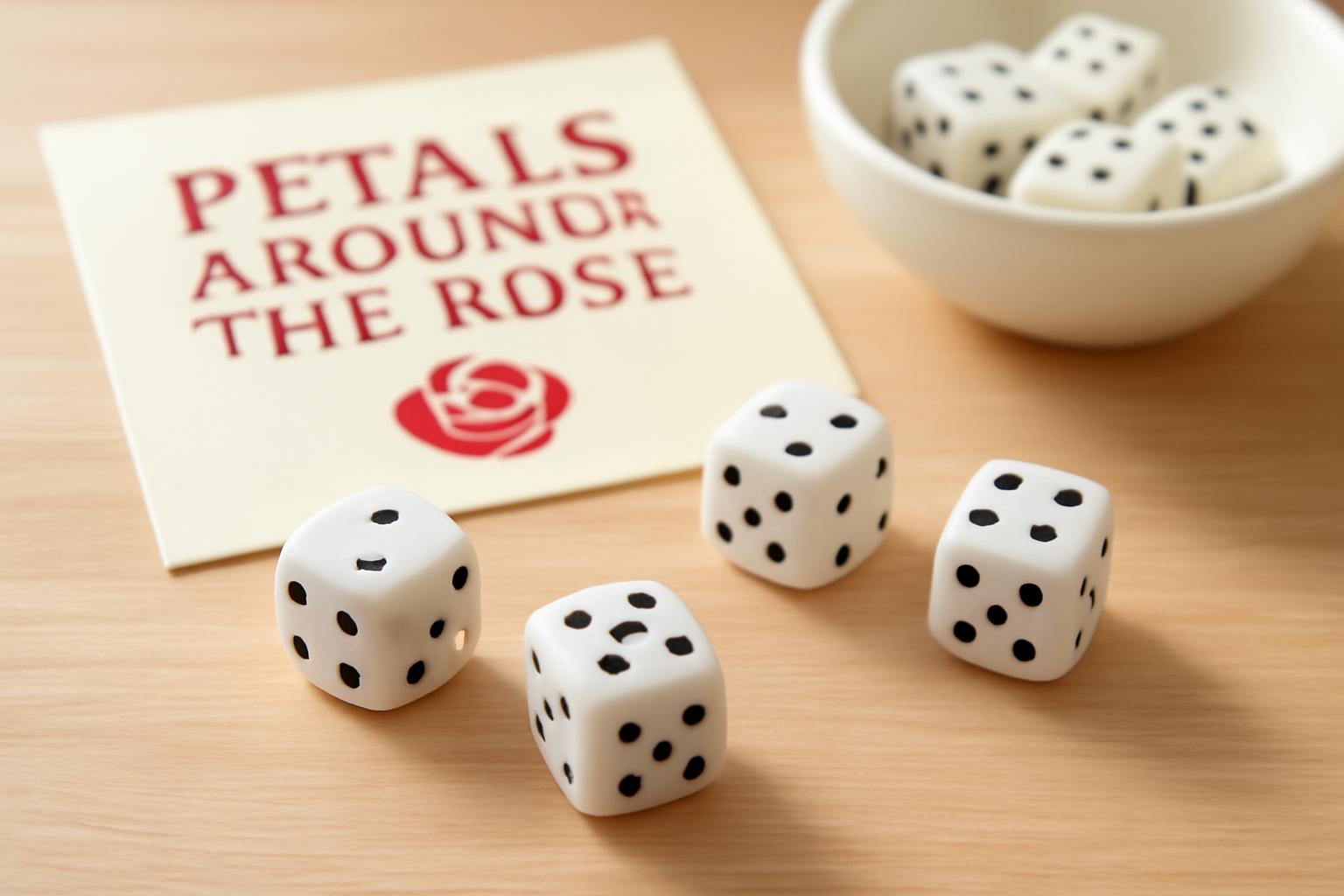
Petals Around the Rose looks like a dice game, but it is not a gambling game. There are no wagers, payouts, opponents, or strategic bets. Instead, the dice display a hidden visual rule. Your task is to discover that rule by comparing several rolls with their announced scores.
The puzzle is easy to run, difficult to explain without spoiling, and satisfying once its title finally makes sense. This guide therefore has two layers: a spoiler-free challenge with progressively stronger hints, followed by the complete solution and worked examples.
What Is Petals Around the Rose?
Petals Around the Rose is a pattern-discovery puzzle played with ordinary six-sided dice. One person—the facilitator—already knows the hidden scoring rule. The facilitator rolls several dice, players inspect the visible top faces and predict the score, and the correct answer is announced after every attempt.
Five dice are customary, but the scoring method does not require exactly five. Instructional versions use four or five dice, while another documented description allows five or six. Changing the number of dice changes the possible totals, not the value assigned to each face. Published descriptions document four-, five-, and six-dice configurations.
Each roll is a self-contained problem. Its score is determined entirely by the face values currently showing. It does not depend on the order in which the dice landed, their positions on the table, or anything shown on a previous roll.
Players are traditionally given only two meaningful clues:
- The name “Petals Around the Rose” is significant.
- Every correct answer is zero or a positive even number.
The challenge is to infer why.
Choose your spoiler level
- Want the pure puzzle? Continue to How to Play Without Spoiling the Secret.
- Want examples first? Go to Practice Rolls: Can You Infer the Pattern?.
- Need a nudge? Open the clues in Three Progressive Hints, one at a time.
- Want the answer now? Jump to Full Solution: What the Rose and Petals Mean.
Do not assume that the puzzle requires advanced arithmetic. The title is not decorative, and the dice are not merely random numbers waiting to be placed into a complicated equation. Look carefully at what ordinary die faces actually look like.
How to Play Without Spoiling the Secret
You need:
- Several ordinary six-sided dice
- Five dice for the customary setup
- At least one facilitator—or a program—that knows the rule
- One or more people trying to discover it
- Optionally, paper for recording rolls, guesses, and announced scores
The basic play loop is straightforward:
- Roll all the dice.
- Leave their top faces visible.
- Let each player inspect the roll and submit a petal count.
- Announce the one correct score for that roll.
- Do not explain how it was calculated.
- Roll again and repeat.
A concise facilitator script is:
“The name of the game is Petals Around the Rose, the name matters, and every answer is zero or even.”
That is enough information to make the puzzle solvable. Each throw has one correct answer, and the facilitator reveals it after guesses have been made. The documented TeachingDemos version uses the customary five-dice setup, limits the clues in this way, and lets players demonstrate understanding through repeated correct predictions. TeachingDemos describes the traditional play loop and facilitator role.
Avoid saying that a guess is “close.” Under the standard rule, a wrong answer is simply wrong; there is one score for the displayed faces. Announce the correct total neutrally and proceed to another example.
Players traditionally show that they understand the rule by predicting several unfamiliar rolls correctly rather than explaining their theory aloud. This protects the puzzle for anyone still solving it and distinguishes genuine understanding from a lucky guess.
Some implementations use six consecutive correct answers as a mastery benchmark. That is a convention, not an official or universal win condition. You can use any streak that suits the group, although a longer run is helpful when a player may have noticed only part of the pattern.
You may also encounter playful traditions such as:
- Calling a successful solver a “Potentate of the Rose”
- Asking solvers to keep the secret
- Tracking a best run or winning streak
- Referring to a fellowship or fraternity of successful players
These customs add atmosphere but do not affect the score. The title “Potentate of the Rose,” the secrecy convention, and the six-answer benchmark all appear in documented versions of the puzzle; none constitutes a formal governing rule.
Practice Rolls: Can You Infer the Pattern?
Study the following examples before opening any hints. The dice are written as numerical face values so that the puzzle does not depend on images.
| Roll | Visible face values | Announced score |
|---|---|---|
| 1 | 4, 1, 6, 3, 6 | 2 |
| 2 | 5, 6, 5, 4, 4 | 8 |
| 3 | 3, 5, 5, 5, 6 | 14 |
| 4 | 2, 4, 6, 1, 2 | 0 |
The first three roll-and-score pairs are published together in a community description of the puzzle; the fourth follows directly from the established face-by-face rule. The same description confirms that previous rolls do not become inputs to the next score. Compare the documented example rolls and announced answers.
Before looking further, ask yourself:
- Which face values appear when the score increases?
- Which values appear in the zero-score roll?
- Does every occurrence of a particular face seem to have the same effect?
- Is the title directing you toward a visual feature rather than arithmetic?
- Why might every possible total be even?
Do not assign importance to left-to-right order. For example, 4, 1, 6, 3, 6 must have the same score as 6, 3, 4, 6, 1. Those rolls contain the same visible face values in a different arrangement.
Likewise, the current result never depends on the score before it. Earlier rolls are evidence from which you can infer the rule, not part of a running calculation.
Try these two additional rolls. Their answers are hidden so you can commit to a prediction first.
Practice roll A: 3, 3, 6, 2, 3 — reveal answer
**Answer: 6**Practice roll B: 5, 2, 5, 1, 5 — reveal answer
**Answer: 12**If you have a tentative theory, test it against all six examples. A complete solution must explain the zero roll, the low score of 2, the larger scores of 8 and 14, and the fact that every total is even.
Still unsure? That is normal. The next section contains three increasingly revealing clues. Open only as many as you need.
Three Progressive Hints
The hints below become progressively more revealing. A facilitator should offer them one at a time. Even a broad suggestion to think visually can make the answer apparent, so allow time to reconsider the examples after each clue.
Hint 1: How should you interpret the title?
Take the words **“rose”** and **“petals”** as a literal visual clue. Do not begin by multiplying the dice, comparing consecutive rolls, reading the values as a code, or searching for an elaborate relationship among the totals. Ask what part of a die face might be represented as an object with other objects arranged around it.Hint 2: Which faces have something in common?
Compare die faces that contain a pip directly in the center with faces that do not. The distinction concerns the arrangement of pips on a standard die face, not merely whether the face value is mathematically odd or even.Hint 3: What should be counted?
On a face that has a central pip, distinguish that central pip from the other pips surrounding it. The title assigns different roles to the center and its surroundings. The final score counts only one of those roles.The clue that every answer is even follows from the shapes of the relevant die faces. Any face that contributes does so through pips arranged symmetrically around another pip, producing contributions in pairs rather than single units.
Stop here if you want one more chance to solve it. The next section gives the complete scoring table, formula, and mental shortcut.
Full Solution: What the Rose and Petals Mean
Full spoiler warning: Everything below reveals the hidden rule.
The central pip on a qualifying odd-numbered face is the rose. The other pips surrounding that center are the petals. The score is the total number of surrounding pips across all the dice.
This interpretation produces the complete scoring table:
| Die face | Visual interpretation | Score |
|---|---|---|
| 1 | One central rose, no surrounding petals | 0 |
| 2 | No central rose | 0 |
| 3 | One central rose with two surrounding petals | 2 |
| 4 | No central rose | 0 |
| 5 | One central rose with four surrounding petals | 4 |
| 6 | No central rose | 0 |
A published solution gives the same face-by-face values: 1 = 0, 2 = 0, 3 = 2, 4 = 0, 5 = 4, and 6 = 0. See the complete rose-and-petals scoring explanation.
The face showing 1 is the important special case. It contains a center pip, so it can be interpreted as a rose, but nothing surrounds it. It therefore contributes zero petals.
Faces showing 2, 4, or 6 also contribute zero, but for a different visual reason: their standard pip arrangements do not contain a central pip around which petals can be counted.
That leaves only two scoring faces:
- A 3 contributes 2
- A 5 contributes 4
The rule can be expressed as:
Total score = 2 × (number of 3s) + 4 × (number of 5s)
The equivalent mental shortcut is easier:
Ignore every 1 and every even face. Count each 3 as two and each 5 as four.
This explains the title. A 5 has a central point surrounded by four outer points; under the metaphor, the center is the rose and the four outer pips are its petals. A 3 has the same structure with two surrounding pips.
It also explains why the answer is always zero or even. Every die contributes zero, two, or four petals. Adding any combination of those values can never produce an odd total.
Worked Examples and Fast Score Calculations
Once you know which faces matter, scoring becomes almost immediate.
Example 1: A zero-score roll
Roll: 2, 4, 6, 1, 2
Score each face:
- 2 → 0
- 4 → 0
- 6 → 0
- 1 → 0
- 2 → 0
Total: 0
The 1 has a rose but no petals. Each even face lacks the required center-and-surroundings pattern.
Example 2: One scoring die
Roll: 4, 1, 6, 3, 6
Only the 3 contributes:
- 4 → 0
- 1 → 0
- 6 → 0
- 3 → 2
- 6 → 0
Total: 2
This is a useful teaching roll because it isolates the effect of a single 3 while surrounding it with non-scoring faces.
Example 3: Two 5s
Roll: 5, 6, 5, 4, 4
Each 5 contributes four:
- 5 → 4
- 6 → 0
- 5 → 4
- 4 → 0
- 4 → 0
Total: 4 + 4 = 8
Example 4: A mixed high score
Roll: 3, 5, 5, 5, 6
Add the contribution from each die:
- 3 → 2
- 5 → 4
- 5 → 4
- 5 → 4
- 6 → 0
Total: 2 + 4 + 4 + 4 + 0 = 14
The totals in Examples 2 through 4 match the published example sequence used to introduce the puzzle. The three documented rolls score 2, 8, and 14 respectively.
Example 5: Several 3s
Roll: 3, 3, 4, 3, 1
Each 3 contributes independently:
- 3 → 2
- 3 → 2
- 4 → 0
- 3 → 2
- 1 → 0
Total: 2 + 2 + 2 = 6
Do not combine repeated faces into a new pattern. Three dice showing 3 simply contribute three separate groups of two petals.
Visual method and formula method
Consider the same roll using both approaches:
Roll: 5, 3, 2, 5, 1
Using the visual method:
- The first 5 has four pips around its center.
- The 3 has two pips around its center.
- The 2 has no center.
- The second 5 has four pips around its center.
- The 1 has a center but nothing around it.
Therefore:
4 + 2 + 0 + 4 + 0 = 10
Using the formula method:
- Number of 3s: 1
- Number of 5s: 2
Then:
2(1) + 4(2) = 2 + 8 = 10
Both methods perform the same calculation. The visual method explains why the rule works; the formula makes repeated scoring faster.
Maximum possible scores
A 5 is the highest-scoring face because it contributes four petals. The maximum therefore occurs when every die shows 5:
| Number of dice | Maximum roll | Calculation | Maximum score |
|---|---|---|---|
| 4 | 5, 5, 5, 5 | 4 × 4 | 16 |
| 5 | 5, 5, 5, 5, 5 | 5 × 4 | 20 |
| 6 | 5, 5, 5, 5, 5, 5 | 6 × 4 | 24 |
These are direct calculations from the established rule that each 5 contributes four petals. For any number of dice n, the maximum is 4n. The documented scoring table establishes the four-point value of each 5.
Practice-roll answer key
The hidden practice rolls were:
-
Roll A:
3, 3, 6, 2, 3Three 3s contribute2 + 2 + 2, so the score is 6. -
Roll B:
5, 2, 5, 1, 5Three 5s contribute4 + 4 + 4, so the score is 12.
Both answers follow from the documented rule that a 3 scores two, a 5 scores four, and all other faces score zero. The compact scoring formula is also recorded in this puzzle overview.
How to Host the Puzzle for a Class, Family, or Group
Begin with five dice unless you have a reason to use another number. Four dice make a roll quicker to scan, while six provide more visible information. The face-scoring rule remains unchanged.
A reliable round-by-round procedure is:
- Roll all the dice where everyone can inspect them.
- Read the face values aloud or display them in text.
- Give players time to make independent guesses.
- Record the guesses if desired.
- Announce the correct score without explaining it.
- Roll again.
- Continue until players can predict unfamiliar rolls consistently.
Independent guesses are usually preferable to a single group answer. Otherwise, one outspoken participant may guide everyone else, while quieter players lose the chance to discover the pattern independently.
Choose informative rolls
Aim to include:
- A zero-score roll, such as
2, 4, 6, 1, 2 - A roll with exactly one 3
- A roll with exactly one 5
- A roll containing both a 3 and a 5
- A roll with several contributing dice
- Plenty of 2s, 4s, and 6s as distractors
Do not present only high-scoring rolls. A zero result is particularly useful because it eliminates many theories involving the sum, product, order, or total number of pips.
If you deliberately choose rolls rather than generating them randomly, there is no need to disclose that while the group is solving. The players’ task is to interpret the visible examples, not to infer the host’s selection strategy.
Verify understanding with new rolls
One correct prediction may be luck. Several correct predictions across meaningfully different rolls provide stronger evidence that a player understands the rule.
A useful test sequence contains:
- A roll with no 3s or 5s
- A roll with one 3
- A roll with one 5
- A mixed roll containing both
- A roll with repeated 3s or repeated 5s
One interactive implementation defines six consecutive correct answers as its win condition, but that threshold belongs to that implementation rather than to an official universal rule. The playable version states its six-answer streak requirement directly.
Do not force successful players to explain the answer aloud while others are still working. Instead, quietly test them with several new rolls or ask them to write down the rule and show it only to the facilitator.
Hosting remotely
The puzzle works in a video call, classroom chat, group message, or plain-text document. Write the visible faces as a comma-separated list:
Roll:
4, 1, 6, 3, 6What is the score?
Text values eliminate disagreements about blurry images or dice viewed at an angle.
If you use diagrams or die images:
- Give every image descriptive alt text.
- Print the numerical face values beside or beneath it.
- Do not encode the example exclusively through color.
- Keep the left-to-right reading order consistent.
- Read the roll aloud when presenting live.
Useful alt text would be: “Five dice showing 4, 1, 6, 3, and 6.” It should communicate the information needed to solve the puzzle, not merely say “dice image.”
Separate mechanics from traditions
The core mechanics shared by documented versions are:
- Roll ordinary six-sided dice.
- Use the visible top faces.
- Calculate one score from the hidden rule.
- Let players infer the rule from examples.
Everything else is optional:
- A six-answer streak
- A streak counter
- A secrecy pledge
- The title “Potentate of the Rose”
- A fellowship or fraternity theme
- Certificates or honorary awards
- A requirement that successful players remain silent
Use these traditions if they make the session playful. Drop them if they create confusion, pressure, or unnecessary competition.
Common Misunderstandings, Variations, and What Is Actually Known
The puzzle invites overcomplication because players naturally search for arithmetic relationships. A proposed rule may fit one or two examples by coincidence, so it is important to distinguish essential mechanics from accidental features.
Position and order do not matter
The score is unaffected by:
- The left-to-right order of the dice
- Their distance from one another
- Whether they form a line, circle, or cluster
- Which die was rolled first
- Their orientation around the vertical axis
- Scores from previous rounds
Only the current top-face values matter. Rearranging 3, 5, 2, 6, 1 as 6, 1, 5, 3, 2 cannot change the result because the same faces are present.
Test elaborate theories with diagnostic rolls
If you think you have found a numerical formula, try it against three simple cases:
- Zero test:
2, 4, 6, 1, 2must score 0. - Single-3 test:
2, 3, 4, 6, 1must score 2. - Single-5 test:
2, 5, 4, 6, 1must score 4.
A theory that cannot distinguish these rolls is incomplete. Diagnostic rolls are more useful than complicated combinations because each isolates one important face.
Also test permutations. If a theory produces different answers when the same face values are rearranged, it cannot be the standard Petals Around the Rose rule.
Five dice are customary, not mandatory
Using five dice is a convention rather than a mathematical requirement. Four- and six-dice versions work because each die is scored independently.
Changing the number of dice affects only practical features:
- More dice produce more combinations.
- Fewer dice are easier to scan.
- Each additional die raises the possible maximum by four.
- The individual face values remain fixed.
There is no need to modify the metaphor or formula.
Not everyone finds the title equally intuitive
Some solvers recognize the center-and-surroundings pattern as soon as they take the title literally. Others do not naturally interpret a central pip as a rose and the outer pips as petals.
That difference reflects how the metaphor works for a particular person, not a separate scoring rule. An informal discussion records a player correctly describing the center-and-surroundings solution while criticizing the rose metaphor as unclear. The discussion illustrates why the title may feel intuitive to some solvers and strained to others.
When hosting, avoid suggesting that someone “should” have noticed the answer. People attend to different visual and numerical features.
The origin is not reliably established
One published solution identifies the author as unknown and explicitly states that the puzzle’s origin is not known.
Some secondary pages repeat a story connecting the puzzle with Bill Gates, but the available material does not provide sufficient primary documentation to verify that account. It should therefore be treated as an anecdote, not established history.
Claims that intelligence determines solving time are also unsupported. Solving speed may vary with familiarity, interpretation of the title, attention, the examples presented, and chance. It should not be used as a measure of intelligence.
This is not a casino game
Although Petals Around the Rose uses dice and numerical scores, it has no casino mechanism. There is:
- No betting
- No payout schedule
- No house edge
- No expected-value decision
- No competition against a dealer
- No strategic choice that changes the score
It is a fixed-rule logic puzzle. The dice generate examples, and the player tries to infer how those examples are scored.
Frequently asked questions
How many dice do you need for Petals Around the Rose?
Five standard six-sided dice are customary and make a good starting setup. Four or six dice also work because each die is scored independently. Changing the number of dice affects the possible total and the amount of information in each roll, not the scoring method.
Why is every Petals Around the Rose score zero or even?
Only faces showing 3 and 5 contribute. A 3 adds two petals, and a 5 adds four. Every other face adds zero.
Therefore:
Score = 2(number of 3s) + 4(number of 5s)
A total composed entirely of zeros, twos, and fours cannot be odd.
What is the highest possible score?
The maximum occurs when every die shows 5 because each 5 contributes four petals:
- Four dice: 16
- Five dice: 20
- Six dice: 24
For any number of dice n, the maximum score is 4n.
Do the arrangement of the dice or previous rolls affect the answer?
No. Only the current top-face values affect the score. Dice order, position, spacing, orientation, and previous results are irrelevant.
Earlier rolls help players infer the hidden rule, but they are not part of the next calculation. The same collection of visible face values always produces the same score.
Who invented Petals Around the Rose?
The inventor is not reliably established. Published versions repeat historical stories, but the available documentation does not justify assigning the puzzle confidently to a particular person, date, or place. A puzzle explainer that publishes the full solution also lists the author as unknown and says the origin is unknown.
Once you know the rule, the fastest shortcut is simple: ignore 1s and all even faces, count each 3 as two, and count each 5 as four. If you enjoyed the moment of discovery, preserve it for someone else by hosting a spoiler-free round. The scoring rule is fixed; six-answer streaks, secrecy promises, fellowships, and honorary titles are optional traditions.