 ExSpade
How to Set Up Pool Table Balls for American 8-Ball, 9-Ball, and UK Rule Variations
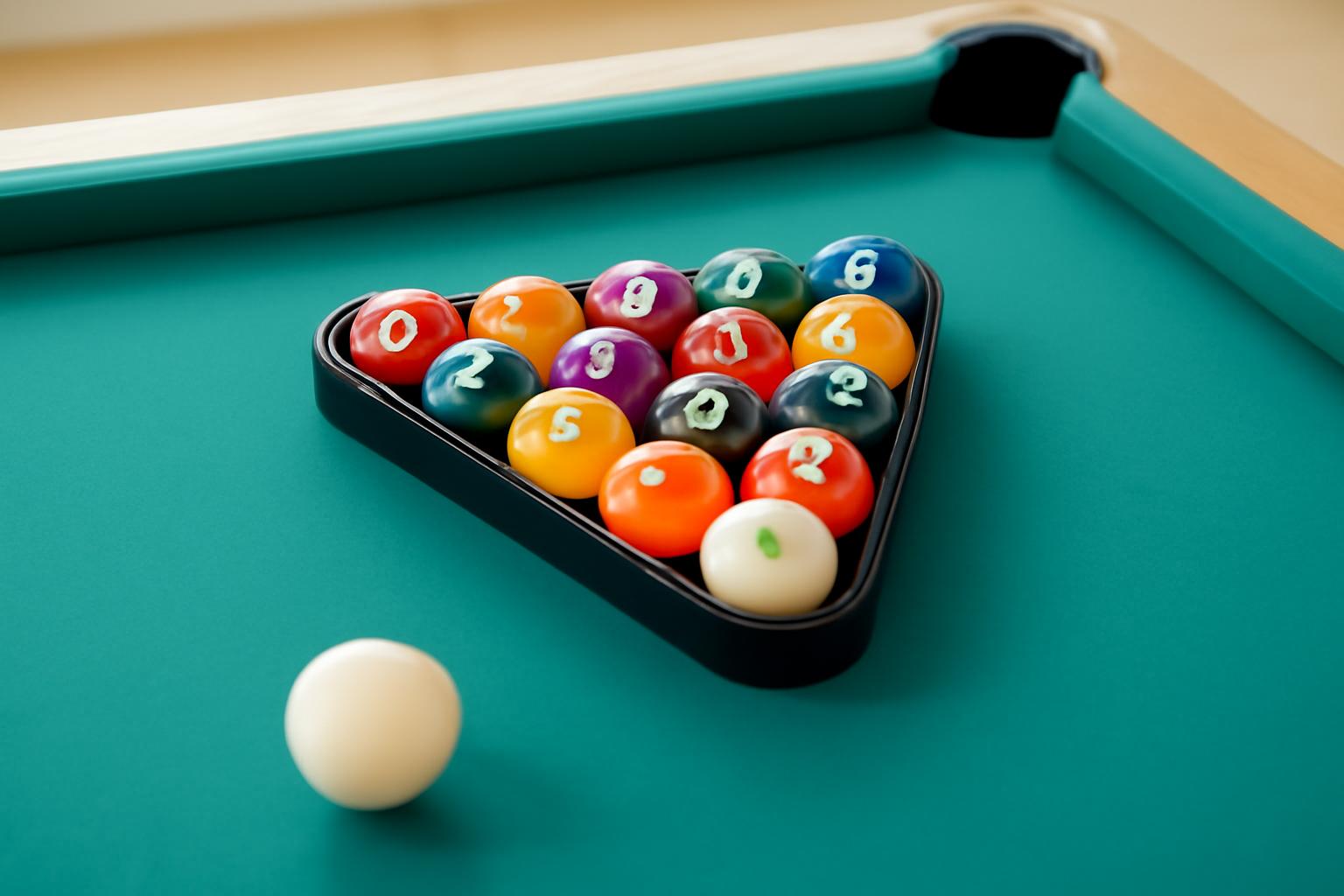
Overview
To set up pool table balls for standard American 8-ball, place all 15 object balls in the triangle rack at the foot end of the table, put the 8-ball in the center, put one solid and one stripe in the two rear corners, fill the rest randomly, align the apex ball on the foot spot, and compress the balls until every one touches its neighbors. That is the whole job for the most common game.
Success is observable: the apex ball sits on the foot spot, the 8-ball is in the middle of the third row, the rear corners hold balls from opposite groups, and no gaps are visible anywhere in the formation after you lift the triangle. If any ball moves when you remove the frame, you put the triangle back and tighten again, as Liberty Games instructs.
One warning before you start: 9-ball uses a diamond of nine balls with different fixed positions, and UK 8-ball uses a color-group pattern rather than the mostly random American fill. Confirm which game you are playing before you follow any layout.
Choose the game and prepare the right balls and rack
Identify the game first, because the three common setups are not interchangeable. A standard pool set contains 16 balls in total, 15 object balls numbered 1 through 15 plus one solid white cue ball, according to HB Home Furnishings. The cue ball never goes inside the rack in any of these games; it stays out of the frame and is only placed on the table for the break.
Use this quick selector to pick your procedure:
- American 8-ball: solids and stripes numbered 1 through 15, a triangle rack, all 15 object balls inside it.
- 9-ball: only balls 1 through 9, a diamond-shaped rack.
- UK 8-ball: typically red and yellow groups plus a black ball, a triangle rack, and a group-based pattern rather than random fill.
If your set has numbered spots and stripes but you are playing UK 8-ball rules, that is fine. Pool Tables Online confirms that the racking pattern is exactly the same and that the numbers on the balls are not used under normal UK 8-ball rules.
Cue-ball placement for the break depends on the ruleset. The BCA rules definitions describe the break shot as the cue ball played from behind the head string, the end opposite the rack. Under the UK-oriented Blackball rules guide, the cue ball may be positioned anywhere within baulk before breaking. Check the exact rule your table or league uses.
Rack standard American 8-ball in five steps
The American 8-ball procedure below runs in five ordered steps: locate the foot spot, load the triangle, set the fixed positions, fill the remaining spaces, then tighten and lift. Each step ends with a visible check so you know it is done before you move on. Where the supplied sources disagree on a convention, such as which ball belongs at the apex, the step says so directly instead of presenting a house habit as an official rule.
Step 1: Find the foot end, foot spot, and apex
Place the triangle rack at the foot end of the table, the end where the object balls begin the game. The BCA rules definitions define the foot end as where the object balls usually begin and the head end as where the cue ball usually begins. The foot spot is the point where the foot string, the line bounding the quarter of the table closest to the foot rail, crosses the long string running down the center of the table lengthwise.
Learn three rack terms before you place any balls: the apex is the single front ball pointing toward the head end, the center is the middle position of the third row, and the rear corners are the two outer positions of the back row of five.
If the table has no visible foot-spot marker, use the geometry from the BCA definitions: find the point on the table’s long centerline that sits one quarter of the table length from the foot rail. That intersection is the foot spot. Success check: the apex position of your triangle sits centered on that spot, pointing at the head end.
Step 2: Place all 15 object balls in the triangle
Put all 15 numbered object balls inside the triangle and keep the white cue ball out of it. Mark Richard Cues confirms that American 8-ball uses a triangle rack with all 15 object balls, and the standard set described by HB Home Furnishings pairs those 15 with a single white cue ball that plays from outside the rack.
Do not worry about order yet; this step is only about getting the right count into the frame. Success check: the triangle is completely full with five rows of balls (one, two, three, four, five), no empty positions remain, and the white ball is sitting outside the rack. If you have a gap, a ball is missing; if the cue ball is inside, swap it out before continuing.
Step 3: Set the fixed 8-ball and rear-corner positions
Two constraints are fixed before anything else. First, place the 8-ball in the center of the triangle, the middle position of the third row. Second, place one solid ball in one rear corner and one striped ball in the other rear corner. Both Sawyer Twain and HB Home Furnishings state these positions in the same terms: 8-ball in the center, one solid and one stripe in the back corners.
The apex ball is more flexible than many players assume. Liberty Games states that the ball in the apex corner can be either a spot or a stripe, and it is that apex ball which sits on the foot spot. Many venues habitually put the 1-ball at the apex, but treat that as a house convention rather than a universal requirement, and note Liberty Games’ own caution that many leagues, bars, and players use different racking rules, so it is polite to check.
Success check: before any random filling, the 8-ball occupies the exact center and the two rear corners hold balls from opposite groups.
Step 4: Fill the remaining positions
Fill every remaining position randomly, but only after the fixed positions from Step 3 are satisfied. Both Sawyer Twain and HB Home Furnishings give the same order of operations: set the 8-ball in the center and the opposite-group corners first, then arrange the remaining balls randomly.
“Random” has a precise meaning here. It applies to the unassigned positions only; it does not license you to shuffle the 8-ball out of the center or to put two solids in the rear corners. If you randomize first and place the fixed balls afterward, you will usually end up swapping balls and loosening the formation.
Success check: all 15 object balls are in the frame, the 8-ball is still in the center, and the rear corners still hold one solid and one stripe. If a fixed ball got displaced during filling, swap it back now.
Step 5: Tighten the rack and lift the triangle
Compress the balls together with your hands until every ball touches its neighbors, then remove the triangle while keeping that pressure on. Liberty Games describes exactly this technique: compress the balls together with your hands while removing the triangle for a tight rack. Mark Richard Cues is blunt about the standard: never allow any gaps in the rack, because a tight rack translates to a powerful and controlled break shot. Sawyer Twain adds the fairness angle: a loose rack can result in poor breaks and unfair gameplay.
Push the formation forward toward the apex so all contact pressure flows to the front ball on the foot spot, hold the balls steady with your fingers, and lift the frame slowly and evenly. Mark Richard Cues’ instruction is to lift slowly and evenly without disturbing or shifting any of the balls.
Success check: after the triangle is fully clear of the table, the formation is stationary and shows no visible gaps between any two neighboring balls. If any ball moved while you removed the triangle, follow Liberty Games’ correction: point it out, put the triangle back over the balls, and tighten them up again before lifting a second time.
Check the rack before the break
Run one final inspection before anyone places the cue ball. This is a pass-or-rerack gate, not a formality: a rack that fails any check below should go back under the triangle.
- The apex ball sits on the foot spot, per Sawyer Twain’s placement rule for a proper break.
- The 8-ball is in the center and the rear corners hold opposite groups.
- Every ball touches its neighbors with no visible gaps, per Mark Richard Cues’ no-gaps standard.
- Nothing shifted when the triangle came off; if it did, rerack per Liberty Games.
A useful mental test: the finished rack should behave like one connected unit, so that force applied at the apex travels through the whole formation. Visible daylight between any two balls means the energy of the break will leak there, and the honest fix is to rerack, not to nudge one ball by hand and hope.
Worked example: verify an American 8-ball rack
Suppose you have just lifted the triangle on a home table and want to confirm the rack in about fifteen seconds. Work front to back. First, sight down the table’s centerline: the apex ball should sit on the foot spot with the formation pointing straight at the head end, matching Sawyer Twain’s alignment rule. Second, look at the third row: the middle ball must be the black 8-ball, the fixed center position given by both Sawyer Twain and HB Home Furnishings. Third, check the back row’s two outer balls: one solid, one stripe, in either order. Fourth, confirm the remaining unassigned positions were simply filled randomly; there is nothing else to verify about them, because no other position is fixed. Finally, crouch to table level and scan for gaps: 15 balls, every one touching its neighbors, nothing moved by the lift. All five checks pass, and the rack is ready. Any single failure means the triangle goes back on.
Use the correct setup for 9-ball or UK 8-ball
Do not reuse the American 8-ball layout for other games. 9-ball uses fewer balls, a different rack shape, and different fixed positions. UK 8-ball uses the same triangle count but replaces the mostly random American fill with a color-group pattern, and its conventions vary by league and era. The two subsections below give the supported setup for each game; pick the one that matches the balls and rules in front of you.
9-ball setup
9-ball uses only balls 1 through 9 in a diamond-shaped rack, with two fixed positions. HB Home Furnishings gives the full arrangement:
- Use a diamond-shaped rack.
- Place the 1-ball at the front of the diamond.
- Place the 9-ball in the center.
- Arrange the remaining balls randomly in the other positions.
Unlike the American 8-ball apex, the front ball here is not optional: Mark Richard Cues specifies placing the 1-ball at the front, on the foot spot. The 9-ball’s center position is equally fixed, and the same instruction appears in the Pool Tables Online description of the diamond: 1-ball at the front, 9-ball in the centre, all other balls placed randomly in the remaining positions.
The tightening technique from Step 5 applies unchanged. Compress the diamond so all nine balls touch, keep pressure toward the 1-ball at the apex, and lift the rack slowly and evenly. Success check: 1-ball on the foot spot, 9-ball dead center, no gaps, nothing shifted when the diamond came off.
UK 8-ball setup
UK 8-ball uses a triangle like the American game, but the arrangement follows a group pattern rather than random fill. The balls are typically two color groups, reds and yellows, plus a black ball, and the black takes the key fixed position. The Blackball rules visual guide, describing WPA-sanctioned blackball as played in the UK, instructs you to rack the balls with the black ball positioned at the intersection of two imaginary diagonal lines through the triangle. Liberty Games notes the alignment difference from the American game: in British pool the 8-ball, meaning the black, is placed on the foot spot, whereas the American apex ball takes that spot.
The exact row-by-row color pattern is where the evidence stops short of one universal answer. Pool Tables Online explains that UK pool has gone through different rule eras and league traditions, and that the current standard competitive layout differs from the older red-and-yellow pattern only in the arrangement of the centre section of the back row. Liberty Games describes one convention in which the two rear corners are different colours, two stripes of two same-colour balls sit next to those, and a stripe of three same-colour balls on the right meets two of the same colour to form a J-shape, while explicitly warning that many leagues and venues rack differently. Given that spread, follow the pattern your league or venue specifies rather than treating any single diagram as official everywhere.
If your only set is numbered spots and stripes, Pool Tables Online confirms you can play UK 8-ball with them: the racking pattern is exactly the same, one group stands in for reds and the other for yellows, and the numbers on the balls are ignored. For the break, the Blackball guide places the cue ball anywhere within baulk, and the lag winner decides who breaks first.
Troubleshoot a loose or disturbed rack
Most racking failures show up in the last ten seconds of the job, when you compress the balls and lift the frame. Each problem below has a specific cause and a supported fix, and none of them is solved by breaking anyway and hoping the spread looks fair.
- Visible gaps after lifting the triangle. The formation was not fully compressed before the lift. Mark Richard Cues’ standard is zero gaps, so put the triangle back, compress the balls together with your hands as Liberty Games describes, and lift again while maintaining pressure.
- Rear balls keep separating when you push forward. Pushing only from the back sends the back row forward while the frame holds the front balls still, opening seams behind the apex. Compress the whole group with your fingers inside the frame so pressure flows from the back row through to the apex ball, then hold that contact as the triangle comes off.
- A ball moves during triangle removal. Follow Liberty Games’ explicit recovery rule: point it out, put the triangle back, tighten the balls up again, and lift more slowly and evenly on the second attempt, per Mark Richard Cues’ lifting instruction.
- The apex is off the foot spot or the rack sits crooked. Sawyer Twain requires the apex ball exactly on the foot spot for a proper break. Reposition the whole frame before tightening; sliding individual balls after the lift usually creates new gaps.
- You cannot find the foot spot. Use the BCA geometric definition: the foot spot is where the foot string, one quarter of the table length from the foot rail, meets the long centerline. Estimate that intersection and center the apex there.
Once the rack passes every check without a rerack, place the cue ball according to your ruleset: consult the applicable American ruleset for placement in the American game, or position the cue ball anywhere within baulk under Blackball rules, and break. A tight, verified rack is the fairest possible start either game allows.